With colds, flu and COVID-19 all going round in winter, adults get temperatures often too. The NHS page “High temperature (fever) in adults” describes a high temperature as usually a symptom of an infection that often gets better on its own. A high temperature is usually considered to be 38C or above, but the page says you can still have one when a thermometer reads below 38C if you feel hot, cold or shivery. This sets out how to tell without a thermometer, how to use a digital thermometer under the tongue or in the armpit, which thermometers not to use, the four things to do at home and when to get help, with our notes added. The page was reviewed on 19 October 2026. It covers adults; children’s temperatures are dealt with separately.
1. A high temperature is usually 38C or above. A chest or back hotter than usual, chills or sweating can mean one even without a thermometer.
2. Use a digital thermometer under the tongue or in the armpit. Not glass, infrared or forehead strips.
3. Rest, drink enough that your pee is light yellow, and stay at home until the temperature has gone. Not improving or getting worse: urgent GP or 111.
How to tell if you have a high temperature — NHS
- Your chest or back feels hotter than usual
- Other symptoms such as feeling hot or cold, chills, sweating, or warm, red skin — the page notes redness may be harder to see on black or brown skin
- A thermometer reads 38C or above
The NHS says you may still have a high temperature when a thermometer reads below 38C if you feel hot, cold or shivery. You do not need a thermometer, but you can use one if you have one. “38C or above” is what the page says is usually considered a high temperature.
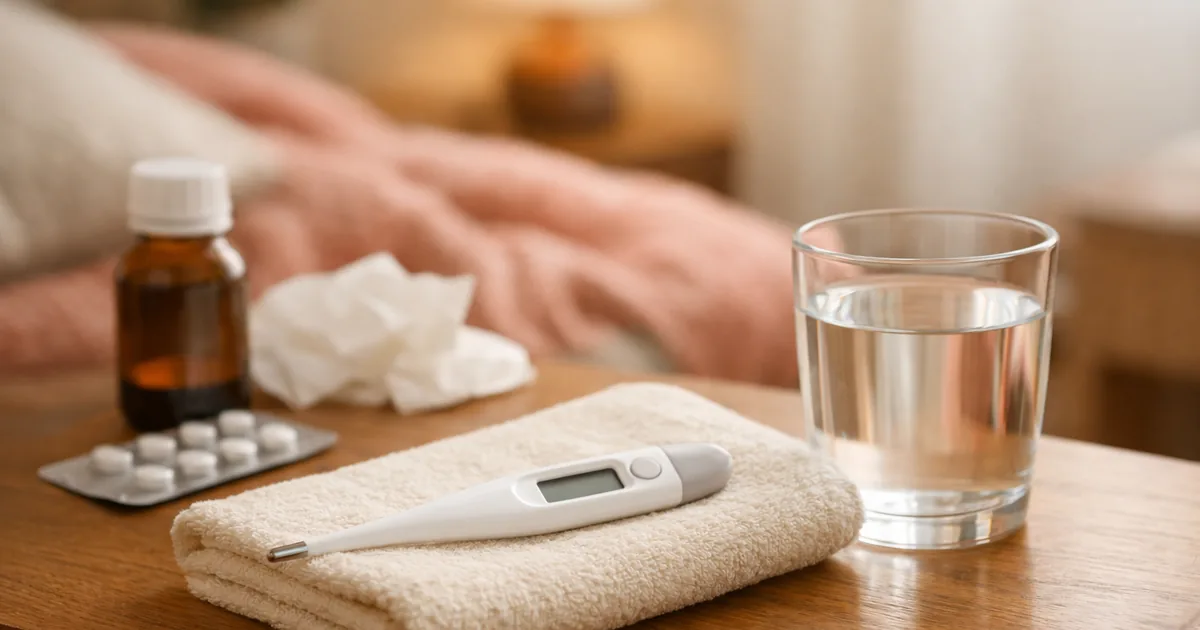
Taking your temperature — NHS
| Type | What the NHS says | Worth noting (our gloss) |
|---|---|---|
| Digital — under the tongue | Clean the tip with cold water and soap and rinse it; turn it on, put the tip under your tongue towards the back of your mouth, close your lips and wait for it to beep or flash | No time in seconds or minutes is given — you wait for the signal |
| Digital — armpit | Put the tip in your armpit and hold your arm tightly against your body until it beeps or flashes | — |
| Ear thermometer | Gently pull the ear up and back before putting it in, and follow the instructions that come with it | — |
| All | Directions vary, so follow the manufacturer’s instructions | — |
| Don’t use | Glass thermometers — they can be dangerous | The page doesn’t say why |
| Don’t use | Infrared thermometers — some do not meet UK regulations | The reason is UK regulation, so it isn’t a statement about Korean-certified devices (our reading) |
| Don’t use | Forehead strips — not accurate | — |
Treating it at home — NHS
| Do | What the NHS says | Worth noting (our gloss) |
|---|---|---|
| Rest | Get lots of rest | — |
| Fluids | Drink plenty of fluids (water is best) to avoid dehydration — enough that your pee is light yellow and clear | Measured by colour, not litres |
| Medicine | Paracetamol or ibuprofen if you feel uncomfortable | “If you feel uncomfortable” — not just because of the number (our reading) |
| Stay at home | Stay at home and avoid contact with other people until you do not have a high temperature | Same test as the COVID-19 page’s return to normal activities |
This page has no “don’t” list — nothing on cold baths, fans, or taking paracetamol and ibuprofen together. We have not filled in what the page does not say. It also gives no doses or timings for the medicines, so check the packet or ask a pharmacist.
When to get help — NHS
| Where | When | Worth noting (our gloss) |
|---|---|---|
| Urgent GP or 111 | A high temperature that is not getting better, or getting worse, after treating it at home | The only threshold this page gives |
There are many causes, but it is often the body fighting an infection such as a cold or flu. It is usually nothing serious, but a temperature that is very high or will not come down can be a sign of something more serious. This page has no 999 list. If a temperature comes with difficulty breathing or chest pain, see the 999 signs in shortness of breath and COVID-19 symptoms; signs of an infection becoming serious are in sepsis.
111 is the UK non-emergency health line and 999 the UK emergency number; in Korea, read 119 for an ambulance (our reading). Children’s temperatures are not covered on this page; see baby fever.
Checklist
- ☐ Chest or back hot, chills or sweating?
- ☐ Digital thermometer, under the tongue or in the armpit
- ☐ Not glass, infrared or forehead strips
- ☐ Rest; drink until your pee is light yellow
- ☐ Stay at home until the temperature has gone
- ☐ Not improving or getting worse: get urgent advice
Questions that remain
Is 37.5C a fever?
The NHS says a high temperature is usually considered 38C or above, but you can have one below 38C if you feel hot, cold or shivery. We read this as not drawing the line at a single number (our reading).
How many days does a fever last?
This page gives no number of days. It says most get better on their own and to get help if not improving or getting worse. The COVID-19 page advises getting help if a temperature lasts 5 days or more.
Can I go to work with a temperature?
The NHS says to stay at home and avoid contact with other people until you do not have a high temperature.
More winter coughs and fevers on this site: flu symptoms, common cold, chest infection, pneumonia, sore throat.
Sources
- NHS — High temperature (fever) in adults — source (page shows: reviewed 19 October 2026, next review 19 October 2029; checked 10 November 2026). The 38C threshold, how to tell, using a thermometer and which not to use, the four home-care steps, the 111 threshold, causes.
- NHS — COVID-19 symptoms and what to do — source (checked 10 November 2026). Get help for a temperature lasting 5 days or more.
- Not read. Korean agency guidance on fever in adults, medicine doses. (The NHS page on fever in children was read on 10 November 2026 and set out in fever in babies — 39°C at 3 to 6 months, 111 after 5 days or more.)
- What we added. The “worth noting” column, the readings on infrared thermometers and “if you feel uncomfortable”, the 119 reading.
Where else to check
- A pharmacy — doses, and whether medicines can be taken together.
- A local clinic — if the temperature isn’t improving or is getting worse.
Written on 10 November 2026. The content is from the NHS; the glosses are ours. It does not replace diagnosis or treatment.