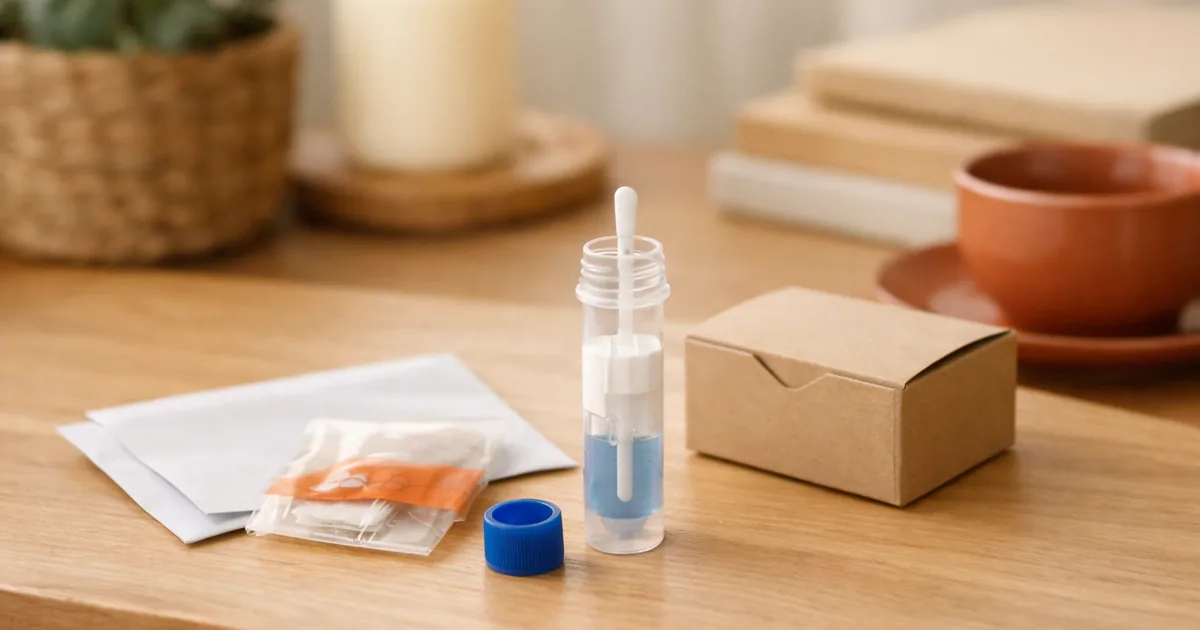
The UK National Health Service (NHS) invites women aged 25 to 64 for cervical screening every 5 years. The first invitation comes a few months before your 25th birthday, and invitations usually stop at 65. The NHS says it is “not a test for cancer” but a test to help prevent it — the sample is checked first for high-risk HPV, and only then for cell changes. Your result sets your next turn: HPV negative, 5 years; unclear, 3 months; HPV positive with no abnormal cells, 1 year; HPV still there after 2 years, or abnormal cells, a colposcopy. We added a checker that works out your next screening date from your age, result and test date.
1. Aged 25 to 64, every 5 years — first invitation a few months before 25; usually stops at 65 (unless a recent test was abnormal).
2. HPV negative 5 years · unclear 3 months · HPV positive (normal cells) 1 year — still positive a year later: another year; still there after 2 years: colposcopy.
3. Under 5 minutes for the test, about 10 for the appointment — bleeding between periods, during or after sex or after the menopause, or unusual discharge: see a GP, don’t wait for screening.
Checker
Age at the next test (approx.): -
Updates as you type. The next date is our sum of “test date + months” (moved to the month’s last day when needed); the NHS sets the real invitation date. Age then is age now plus the years (birthday not used). Results that lead to colposcopy get no date.
For example, a 35-year-old who is HPV negative on 12 November 2026 is next due 60 months later, around 12 November 2031, at about 40 (our sum). HPV negative at 62 puts the next turn at 67, so invitations usually stop. HPV positive with no abnormal cells means 12 months, around 12 November 2027; an unclear result means 3 months, around 12 February 2027 (our sums).
Who and when — NHS
| Item | What the NHS says | Worth noting (ours) |
|---|---|---|
| Who | Women aged 25 to 64; everyone with a cervix should be offered it | — |
| How often | Every 5 years; with HPV you may be invited sooner | Korea: from 20, every 2 years (below) |
| 3 to 5 years | People given a due date before the change from 3 to 5 years may be invited sooner | An old letter’s date may look early |
| First invitation | A few months before your 25th birthday; not before, as it is very rare under 25 and changes often go away on their own | — |
| 65 and over | Usually stops; invited again only if a recent test was abnormal; never screened or not since 50: ask a GP | The checker flags “next turn 65 or over” |
| Total hysterectomy | Womb and cervix removed: no screening, no more invitations | — |
| Missed it | You don’t need to wait for an invitation to book | — |
Trans men and non-binary people with a cervix are invited automatically if registered as female with a GP; if registered as another sex they may not be, and the NHS says to ask a GP surgery, sexual health service or transgender health clinic to set up invitations. Trans women and non-binary people without a cervix don’t need screening.
The four results — NHS
| Result | What the NHS says | Worth noting (ours) |
|---|---|---|
| HPV negative | Very low risk; no further tests even after past cell changes; invited again in 5 years | Checker: 60 months |
| Unclear (inadequate) | Repeat in 3 months; doesn’t mean anything is wrong | Checker: 3 months |
| HPV positive, no abnormal cells | Screening in 1 year, again a year later if still HPV; still there after 2 years: colposcopy | Checker: 12 → 12 → colposcopy |
| HPV positive with abnormal cells | Colposcopy — a hospital procedure that looks closely at the cervix | The NHS says changes won’t get worse while you wait |
Results usually come through the NHS App or by letter; if it takes longer than expected, contact your GP surgery. The NHS also says a positive HPV result doesn’t mean a partner has been unfaithful — HPV can be there without recent sex or new partners.
Why HPV comes first — NHS
- Nearly all cervical cancers are caused by high-risk HPV, the NHS says. Most HPV clears without problems, but high-risk types that stay can lead to cancer if untreated.
- Without high-risk HPV, cervical cancer is very unlikely, even after past cell changes.
- Vaccinated people still go, because the vaccine doesn’t cover every type.
- With no sexual contact the risk is low, but cervical cancer can occur without HPV, so go when invited. Lesbian and bisexual women are at risk if they have had any sexual contact.
On the day — NHS
| Item | NHS advice | Worth noting (ours) |
|---|---|---|
| Time | The test takes under 5 minutes; the appointment about 10 | — |
| Who | Usually a female nurse or doctor | — |
| How | Undress from the waist down behind a screen and lie back; a speculum is put in and opened; a soft brush takes cells; the speculum comes out and you dress | You can stop at any time |
| Making it easier | A skirt or long jumper, someone with you, breathing exercises, a smaller speculum, putting it in yourself, a different position | — |
| Afterwards | Light spotting should stop within a few hours; heavy bleeding or bleeding longer than that: GP | — |
How Korea’s national cervical screening differs
Korea’s national cervical screening offers women aged 20 or over a cervical cytology test every 2 years, free. The ages and interval are as Annex 1 of the Enforcement Decree of the Cancer Control Act (as amended 14 May 2019; current text in force 2 January 2026, Presidential Decree No. 35948; checked 12 November 2026) puts them — “cervical cancer · 2 years · women aged 20 or over”; the test type and the cost are from our national cancer screening by age post (Annex 1 gives only age, interval and who is covered). Side by side (our table):
| Item | UK NHS | Korea (Annex 1 · existing post) |
|---|---|---|
| Starts | 25 (invited a few months before) | Women 20 or over (Annex 1) |
| Ends | Usually 65 | No upper age (Annex 1 says only “or over” — our reading) |
| Interval | 5 years (3 months or 1 year by HPV result) | 2 years (Annex 1) |
| First test | High-risk HPV, then cells if positive | Cervical cytology (existing post) |
Across the 40 years from 25 to 64, staying HPV negative means 8 tests in the UK, while the same span on Korea’s 2-year cycle is 20 (40 years divided by the interval, our sum). We read the gap as coming from the different first test — the NHS says the risk is very low without HPV.
Checklist
- ☐ Aged 25 to 64: every 5 years (first invite a few months before 25)
- ☐ Read the HPV line first: negative 5 years · unclear 3 months · positive 1 year
- ☐ HPV still positive after 2 years, or abnormal cells: colposcopy
- ☐ After 65, only if a recent test was abnormal
- ☐ Bleeding between periods, during or after sex or after the menopause, or unusual discharge: GP now
Whether you are due in Korea this year is in health check-up eligibility; the NHS home test for bowel cancer is in bowel cancer screening NHS.
Questions that remain
How many people test HPV positive?
The NHS pages we read give no percentage.
What happens at a colposcopy?
The NHS colposcopy page (summary, our wording) says you may be referred when screening finds abnormal cells linked to HPV, when two results in a row are unclear, or for symptoms such as bleeding after sex. You may wait up to 6 weeks after the letter; the test usually takes 15 to 20 minutes and you go home afterwards. A speculum is used and the cervix is viewed with a lit magnifier from outside the body; a liquid is applied to show abnormal cells, and a pinhead-sized sample (biopsy) may be taken. Avoid penetrative sex, tampons and vaginal creams for 24 hours before. The most common way to remove abnormal cells is LLETZ (local anaesthetic, about 15 minutes, often the same visit); a cone biopsy removes more under general anaesthetic. If no abnormal cells are seen you are usually told straight away; biopsy results take 4 to 8 weeks, and a normal result means an invitation in 3 or 5 years depending on age. Bleeding after LLETZ can last up to 4 weeks, and you may be told to avoid sex for that time.
Is there a home HPV self-sampling kit?
The pages we read do not mention self-sampling.
Sources
- NHS — Cervical screening — source (checked 12 November 2026). 25 to 64 every 5 years; everyone with a cervix.
- NHS — When you’ll be invited — source (page shows: reviewed 26 June 2025, next review 26 June 2028). First invitation, 3 to 5 years, 65, hysterectomy, trans and non-binary, symptoms.
- NHS — Your results — source (same review date). The four results and 5 years, 3 months, 1 year, 2 years, colposcopy.
- NHS — Why it’s done · What happens at your appointment — why, on the day (same review date). HPV, vaccination, 5 and 10 minutes, steps, bleeding.
- NHS — Colposcopy — source (page reviewed 1 September 2026, next review 1 September 2029; checked 12 November 2026). Reasons for referral, 6 weeks, 24 hours before, 15–20 minutes, biopsy, LLETZ and cone biopsy, 4–8 weeks, 3 or 5 years, aftercare.
- Korea Law Information Center — Enforcement Decree of the Cancer Control Act Art. 8 and Annex 1 — source (current text, in force 2 January 2026, Presidential Decree No. 35948; Annex 1 as amended 14 May 2019; checked 12 November 2026). Six cancers screened; cervical cancer every 2 years for women 20 or over.
- Not read. The “How to book” and “Further help and support” pages, the GOV.UK screening leaflet, Scottish, Welsh and Northern Irish guidance, the UK screening committee recommendation, and the Korean notice setting the test type and cost.
- What we added. The “worth noting” column, the checker’s date and age sums, the Korea table, the 40-year count and our reading of the interval gap.
Where to check further
- Your GP surgery — if no invitation comes, or with symptoms.
- In Korea — the National Health Insurance Service screening eligibility lookup.
Written on 12 November 2026. The content is from the NHS; the glosses and sums are ours.