What should you think about before walking or cycling outside as the weather turns cold? The US National Institute on Aging (NIA), part of the National Institutes of Health, sets out how older adults can exercise safely in their neighbourhood as 29 tips in 6 groups: 6 for thinking ahead, 4 for walking, 6 for road and traffic, 5 for cycling, 4 for hot weather and 4 for cold weather. For cold weather it lists watching for snow and ice, warming up before you go out, several layers of loose clothing, and knowing the signs of hypothermia, and it says to consider exercising inside if it is very windy, cold, hot or humid. This page sets out the NIA page (reviewed 14 January 2025), with a checker that picks the tips for today’s activity, weather and time of day.
1. Thinking ahead — tell others where you are going and when you will be back, carry ID with emergency contacts and a cellphone, wear sturdy shoes and layers you can remove, stick to well-lit places at night, wear bright clothes by day and reflective material and a flashlight at night, check the forecast.
2. On the road — walk facing oncoming traffic, cross at crosswalks, never assume a driver sees you, and remember that rushing increases your risk of falling. On a bike: one that fits, a helmet, tied shoelaces and pant legs.
3. Cold weather — snow and ice, warm up first by marching in place or pumping your arms, loose layers plus a hat, scarf and gloves, the signs of hypothermia. Walking beside a road on a cold day gives 20 tips in 4 groups (our count).
Today’s checker
Groups that apply - · flagged for today (night, alone, bad weather) -
Results update as you type. The 29 tips are the NIA page’s lists, group by group. The 6 “thinking ahead” tips always apply; walking adds the 4 walking tips, walking beside a road adds the 6 road and traffic tips, cycling adds the 5 bicycle tips, and hot or cold weather adds that weather’s 4 — which group goes with which activity is our choice (NIA places road and traffic under walking). The “flagged for today” marks are ours: well-lit places, reflective material and daylight walking at night; ID and a phone when alone; exercising inside in bad weather.
For example, walking on a pavement beside a road on a cold day gives 6 thinking-ahead tips, 4 walking tips, 6 road tips and 4 cold-weather tips: 20 tips in 4 groups (our count). Cycling on the same day gives 6 thinking-ahead, 5 bicycle and 4 cold-weather tips, 15 in 3 groups; gardening on a hot day gives 6 thinking-ahead and 4 hot-weather tips, 10 in 2 groups. Walking alone at night keeps the count at 20 but flags 4 of them.
Before you go — 6 tips for thinking ahead
- Tell someone where you are going and when you plan to be back.
- ID and a phone — carry ID with emergency contact information and a cellphone, especially if you are alone.
- Shoes and clothes — sturdy shoes suited to the activity that give you proper footing; depending on the weather, layers you can remove as your body warms up.
- Stay alert — keep the volume low on your headphones; at night, stick to well-lit places with other people around.
- Be seen — light or brightly coloured clothing by day; reflective material and a flashlight at night; lights on the front and back of your bike.
- Check the forecast — if it is very windy, cold, hot or humid, consider exercising inside: online exercise videos, or walking in a temperature-controlled building such as a shopping mall.
When you walk — 4 walking tips, 6 road and traffic tips
| Group | What NIA says | Worth noting (our gloss) |
|---|---|---|
| Walking 1 | Walk during daylight hours if possible | In winter it gets dark early, so an after-work walk easily becomes a night walk |
| Walking 2 | Choose routes with places to sit in case you want to rest | — |
| Walking 3 | Walk on a sidewalk or path whenever possible; uneven ground or sidewalks are tripping hazards | — |
| Walking 4 | In a city, try parks — many have walking or jogging trails away from traffic | — |
| Road 1 | Always walk facing oncoming traffic | US guidance — on roads without a pavement, the side where you face the traffic |
| Road 2 | Keep as far from traffic as you can; use the guardrail as a barrier where possible | — |
| Road 3 | Cross at crosswalks or intersections, watching traffic and pedestrian signals; don’t jaywalk | — |
| Road 4 | Never assume a driver sees you; try to make eye contact | — |
| Road 5 | Make sure you have plenty of time to cross; rushing increases your risk of falling | More so on ice |
| Road 6 | Look across all lanes and make sure each is clear before you go | — |
How to start brisk walking from 10 minutes a day is in our brisk walking (NHS) guide, and the check that moderate intensity means you can talk but not sing is in our talk test (CDC) guide.
5 cycling tips
NIA calls cycling a fun family activity and a great way to exercise, which some people also use to commute, shop or visit friends, and lists five tips.
- Ride a bike that fits you and works well — maintain the wheels, chain and brakes
- Wear a proper bike helmet
- Tuck and tie your shoelaces and pant legs so they don’t catch in the chain
- Plan a route with a bike lane or path if possible; on roads, choose less traffic and slower speeds
- Obey street signs, signals and road markings
For more on cycling safely it points to the US National Highway Traffic Safety Administration (NHTSA) — we did not open that page this time.
4 hot-weather tips and 4 cold-weather tips
| Weather | What NIA says | Worth noting (our gloss) |
|---|---|---|
| Cold 1 | Watch out for snow and icy sidewalks and stairs | Stairs and shaded paths tend to freeze first |
| Cold 2 | Warm up your muscles first — march in place or pump your arms lightly before you go out | Indoors, then out |
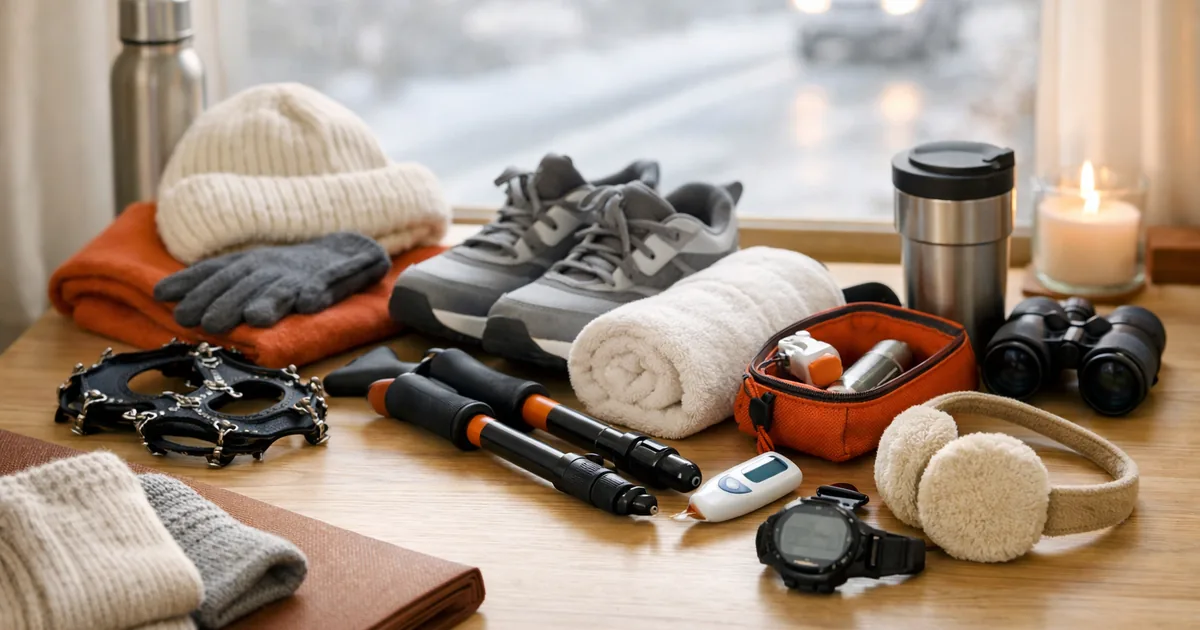
| Cold 3 | Several layers of loose clothing trap warm air between them; a waterproof coat in snow or rain; a hat, scarf and gloves | The same idea as the removable layers in “thinking ahead” |
| Cold 4 | Learn the signs of hypothermia so you can get medical help right away | The signs are in the hypothermia guide below |
| Hot 1 | Drink plenty of water; avoid caffeine and alcohol. If your doctor has told you to limit liquids, ask what to do when it is very hot | — |
| Hot 2 | Clothes that let air circulate and moisture evaporate | — |
| Hot 3 | Sunscreen, sunglasses and a hat | — |
| Hot 4 | Know the signs of heat-related illness such as heatstroke | — |
NIA says you can still exercise outdoors in the colder months “if it’s not too cold”, with a few extra steps. The signs of hypothermia and when it is an emergency are in our hypothermia (NHS) guide, five warm-up moves in our how to warm up before exercising (NHS) guide, and our winter guides together in the winter safety guide.
Checklist
- ☐ Tell someone where you are going and when you will be back; ID, emergency contacts, a phone
- ☐ Sturdy shoes, layers you can remove
- ☐ Bright clothes by day; reflective material, a flashlight and bike lights at night
- ☐ The forecast — very windy, cold, hot or humid means exercising inside
- ☐ Walk facing oncoming traffic, cross at crosswalks, don’t rush
- ☐ On a bike, a helmet and tied shoelaces and pant legs
- ☐ Cold days — ice, warm up first, a hat, scarf and gloves, the signs of hypothermia
Questions that remain
How cold is “too cold”?
The NIA page gives no temperature. It says only “if it’s not too cold”, and to consider exercising inside if it is very windy or cold. So the checker lets you choose the bad-weather box yourself.
What signs of hypothermia does NIA give?
NIA’s separate page “Cold Weather Safety for Older Adults” (reviewed 3 January 2024) defines hypothermia as the body’s core temperature dropping below 95°F (35°C). Early signs it lists are cold feet and hands, a puffy or swollen face, pale skin, shivering or shaking, slowed or slurred speech, and feeling sleepy, angry or confused. With continued cold come stiff, jerky arm and leg movements, a slow heartbeat or breathing, loss of consciousness and eventually death. If you suspect it, call for emergency help right away, move the person somewhere warmer, offer a warm drink and wrap them in dry blankets, towels or coats; at home, set the heat to at least 68°F (20°C) (checked 25 November 2026; Celsius is our conversion). NIA’s infographic “5 Tips for Exercising Safely in Cold Weather” (updated 5 June 2025) gives five: warm up and cool down, dress in layers, watch for snow and ice (low-heeled, rubber-soled shoes), check the weather (indoors if windy, very cold, icy or wet), and plan ahead (know the signs of hypothermia, tell someone where you are going, carry a charged phone).
What can I do indoors in winter?
NIA gives online exercise videos and walking in a temperature-controlled building as examples. NHS videos you can follow at home are in our aerobic workout videos (NHS) guide.
Is this only for older adults?
The page is titled as safety tips for older adults, but nothing in the lists depends on age (our reading). The weekly amount of activity for 65 and over is in our activity guidelines for 65 and over (NHS) guide.
Sources
- NIA (National Institute on Aging, NIH) — Exercising Outdoors: Safety Tips for Older Adults — source (page shows: content reviewed 14 January 2025; checked 25 November 2026). Thinking ahead, walking, road and traffic, cycling, hot weather, cold weather.
- NIA — Cold Weather Safety for Older Adults · 5 Tips for Exercising Safely in Cold Weather — hypothermia page (page shows: content reviewed 3 January 2024) · infographic page (page shows: updated 5 June 2025); checked 25 November 2026. 95°F, early and later signs, what to do, heating to 68°F, five cold-weather exercise tips.
- Not read. The hot-weather infographic linked from the page, the Spanish version, the NHTSA cycling safety page and other organisations’ pages it points to, NIA’s separate page on heatstroke, Korean pedestrian and cycling rules (Road Traffic Act) and Korean cold-wave guidance. We did not reproduce the organisations’ contact details at the foot of the page.
- What we added. Group numbering, the “worth noting” column, the checker’s grouping by activity, its counts and today’s flags, and the sentences marked as our reading, gloss or count.
Where to check further
- Your doctor — if you have been told to limit fluids, or have heart or lung disease and are worried about exercising in the cold.
- The Korea Meteorological Administration forecast — whether a cold-wave, strong-wind or heat warning is in force.
Written on 25 November 2026. The content is from NIA; the glosses and counts are ours.