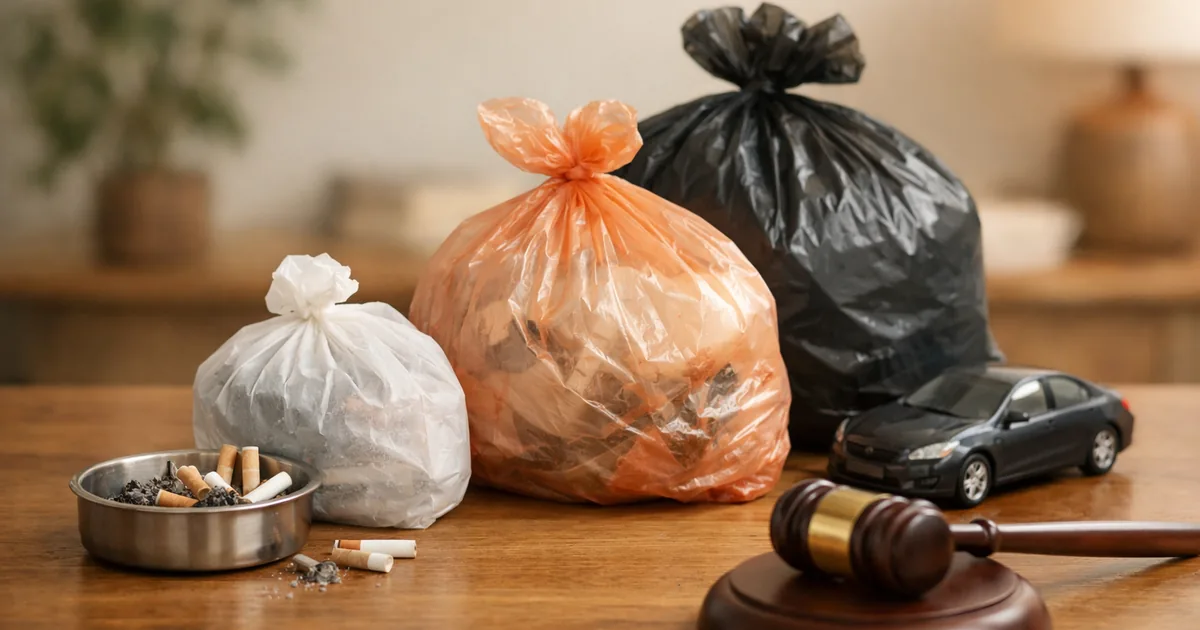
Is flicking a cigarette butt into the street the same offence as pulling over and leaving a bag of rubbish? Korea’s Wastes Control Act bans both in one provision (article 8(1)), but the Decree’s fines table splits the amount five ways by what you dumped and how. A butt is 50,000 won, a bag 200,000 won, rubbish brought by car 500,000 won, and business rubbish 1,000,000 won. We read the article and Annex 8 as written.
1. What you were carrying costs 50,000 won. Dropping household waste you had on you, such as cigarette butts or tissues, is 50,000 won.
2. Bags and outing rubbish cost 200,000 won. Dumping waste in a plastic bag or cloth bundle, or rubbish from resting or an outing, is 200,000 won.
3. Bringing it by vehicle costs 500,000 won. Using a car, handcart or similar is 500,000 won, and household-type waste from business activity 1,000,000 won. Burning it is 500,000 won; burying it 700,000 won.
What counts as dumping — article 8(1)
Wastes Control Act, article 8 (prohibition of dumping of wastes, etc.) (1) No person shall discard wastes anywhere other than places or facilities provided for their collection by the head of a local government or the manager of a facility such as a park or road, or discard household wastes without following the method set by local ordinance or designated by such a manager.
(2) No person shall bury or incinerate wastes anywhere other than an approved or reported waste treatment facility. …
There are two kinds of breach: dumping somewhere not designated, and dumping in a designated place but not by the method set by ordinance (designated bags, collection days and times and so on). In other words, leaving rubbish next to a collection point can still breach paragraph 1 if it is not in the prescribed bag. Article 68(3)1 of the Act sets a fine of up to 1,000,000 won for household-waste breaches, and Annex 8 of the Decree divides the amounts.
Fines — Decree Annex 8 as written
| How | Fine | Annex 8, item ga |
|---|---|---|
| Dropping butts, tissues or other things you were carrying | 50,000 won | 1) (a) |
| Dumping in a plastic bag, cloth bundle or similar | 200,000 won | 1) (b) |
| Dumping rubbish from resting or an outing | 200,000 won | 1) (c) |
| Dumping with a vehicle, handcart or similar | 500,000 won | 1) (d) |
| Dumping household-type waste from business activity | 1,000,000 won | 1) (e) |
| Burning household waste (business: 1,000,000 won) | 500,000 won | 3) |
| Burying household waste (business: 1,000,000 won) | 700,000 won | 2) |
Annex 8 (amended 13 August 2024) has columns for first, second and third or later offences, but all seven lines show the same amount in every column. Repeat offences do not raise them, and a first offence already costs this much. By contrast, ignoring a local government’s cleanliness order (item na) rises from 300,000 to 700,000 to 1,000,000 won.
In one line: the law grades the fine by how you dumped, not how much. A butt or a tissue is “something you were carrying” and costs 50,000 won; the same rubbish gathered in a bag and left behind is 200,000 won, and loaded into a car and dropped off 500,000 won. The more preparation, the heavier the fine.
Reductions
General standard (c) of Annex 8 allows a reduction of up to one half where the breach was minor carelessness or error, or where you promptly corrected or remedied it, among other cases; not for those in arrears. General standard (b) raises the tier for repeat violations within 1 year, but the seven lines above have the same amount at every tier.
Checklist — outings and moving house
- ☐ Take camping, grave-visit and picnic rubbish home — outing rubbish is 200,000 won
- ☐ Do not drive clear-out rubbish somewhere to dump it — vehicles mean 500,000 won
- ☐ Check local rules on designated bags and collection days
- ☐ Do not burn it in the yard — 500,000 won
Questions that remain
What about business waste?
Dumping business-site waste in breach of article 8(1) is a criminal offence under article 63 of the Act (up to 7 years in prison or a fine of up to 70 million won), not an administrative fine. It is a different line from “household-type waste from business activity” in the table above.
Are there rewards for reporting dumping?
Some local governments set them by ordinance, but we did not open individual ordinances. Check your city, county or district website.
Sources
- Wastes Control Act [in force 18 Sep 2026] [Act No. 21467] — original text (checked 29 September 2026). Source for article 8(1) and (2) (dumping, burying and burning), article 63 (business waste penalty) and article 68(3)1 (up to 1,000,000 won).
- Enforcement Decree of the Wastes Control Act [in force 26 Mar 2026] [Presidential Decree No. 36217] — Annex 8, standards for fines. Source for 50,000, 200,000, 500,000, 700,000 and 1,000,000 won and the general standards (1 year, one half).
Where to check further
- How and when to put rubbish out — your local household-waste ordinance and guidance.
- Bulky waste — bulky-waste disposal reporting on your local government website.
Written on 29 September 2026. Articles and annexes are from the National Law Information Center; the tables are ours. Holiday motorway travel is covered in holiday toll exemptions, and no-smoking fines in no-smoking areas.