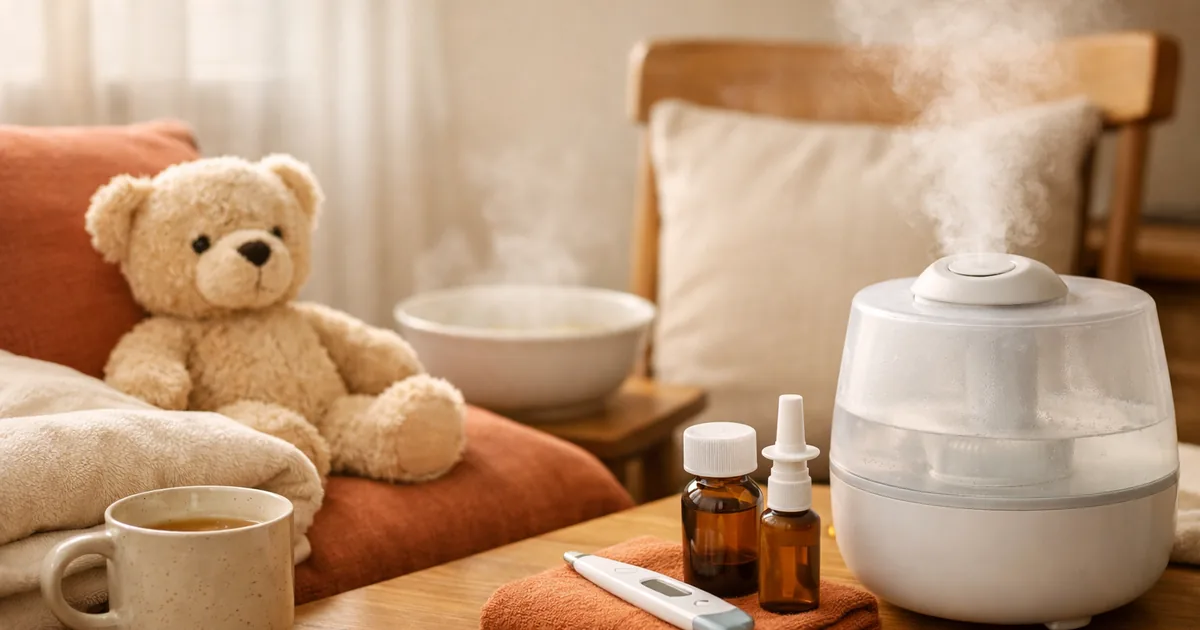
If your voice goes hoarse or disappears after a cold, it may be laryngitis. The NHS describes laryngitis as when your voice box or vocal cords become irritated or swollen, and says it usually goes away by itself within 1 to 2 weeks. It starts suddenly and usually gets worse during the first 3 days. The advice: speak as little as possible, drink plenty of fluids, and keep the air moist with bowls of water. And don’t talk loudly or whisper — both strain your voice. See a GP if symptoms don’t improve after 2 weeks. This sets out the NHS page “Laryngitis”.
1. Usually gone within 1 to 2 weeks; gets worse during the first 3 days.
2. Speak little, drink plenty, put out bowls of water. No loud talking — and no whispering either.
3. No better after 2 weeks: GP. Hard to swallow: 111. Difficulty breathing: 999.
Symptoms — NHS
| Who | Symptoms (NHS) | Worth noting (our gloss) |
|---|---|---|
| Adults | A hoarse (croaky) voice; sometimes losing your voice | — |
| Adults | An irritating cough that won’t go away; always clearing your throat; a sore throat | Throat clearing is also listed as a cause |
| Children (also) | Temperature of 38C or above; off their food or drink | — |
| Children (also) | Difficulty breathing — rare | See the 999 advice below |
For a child with a barking cough and a rasping sound when breathing in, see croup.
Dos and don’ts — NHS
| Type | What the NHS says | Worth noting (our gloss) |
|---|---|---|
| Do | Speak as little as possible | — |
| Do | Drink plenty of fluids | — |
| Do | Keep the air moist by putting out bowls of water | — |
| Do | Gargle with warm salty water — not for children | — |
| Don’t | Talk loudly or whisper — both strain your voice | Unlike the common idea that whispering rests it |
| Don’t | Smoke; spend time in smoky or dusty places | — |
| Don’t | Drink too much caffeine or alcohol | See caffeine and alcohol units |
A pharmacist can suggest paracetamol or ibuprofen, cough syrup, and gargles or lozenges for the pain. Caffeine amounts are in daily caffeine limit, and alcohol in alcohol units.
Where to go — NHS
| Where | When | Worth noting (our gloss) |
|---|---|---|
| GP (non-urgent) | No better after 2 weeks | — |
| GP (non-urgent) | You keep getting laryngitis or voice problems | — |
| 111 | Very painful, or difficult to swallow | — |
| 999 or A&E | You or your child have difficulty breathing | Don’t drive yourself |
Why it happens — NHS
Laryngitis usually happens with a viral infection such as a cold or flu. Other causes include allergies (for example to dust and fumes), acid reflux, prolonged coughing and constant throat clearing.
Colds are covered in common cold, and acid reflux in heartburn and acid reflux.
Checklist
- ☐ Speak little — and don’t whisper
- ☐ Plenty of fluids; bowls of water for humidity
- ☐ Avoid smoke, dust, heavy drinking and too much caffeine
- ☐ Still hoarse after 2 weeks: GP
- ☐ Difficulty breathing: 999
Questions that remain
Doesn’t whispering rest your voice?
The NHS says talking loudly and whispering both strain your voice. Speaking as little as possible is what it recommends.
Does steam help?
This page doesn’t mention steam; it only says to keep the air moist with bowls of water.
Sources
- NHS — Laryngitis — source (page shows: reviewed 17 January 2024, next review 17 January 2027; checked 14 October 2026). Definition, 1 to 2 weeks, first 3 days, adult and child symptoms (38C), dos and don’ts, pharmacy, 2 weeks, 111 and 999, causes.
- Not read. Korean agency guidance on laryngitis.
- What we added. The “worth noting” column.
Where else to check
- Your GP or an ENT clinic — if you’re still hoarse after 2 weeks.
Written on 14 October 2026. The content is from the NHS; the glosses are ours. It does not replace diagnosis or treatment.