A kerosene heater warms a room quickly without electricity, but it burns an open flame, so the wrong fuel or poor ventilation can turn into a serious accident. The US Consumer Product Safety Commission (CPSC) put kerosene heaters behind about 1,900 residential fires and about 60 deaths in 1987, and named one way to cut sudden uncontrolled flaming (“flare-up”) sharply: use only 1K kerosene, never gasoline or non-kerosene fuels. Refuel outdoors with the heater off and cool, keep it at least 3 feet (about 0.9 m) from anything that burns, and put it out before going to sleep. We set out three CPSC releases and add a checker that runs your kerosene heater habits through ten points.
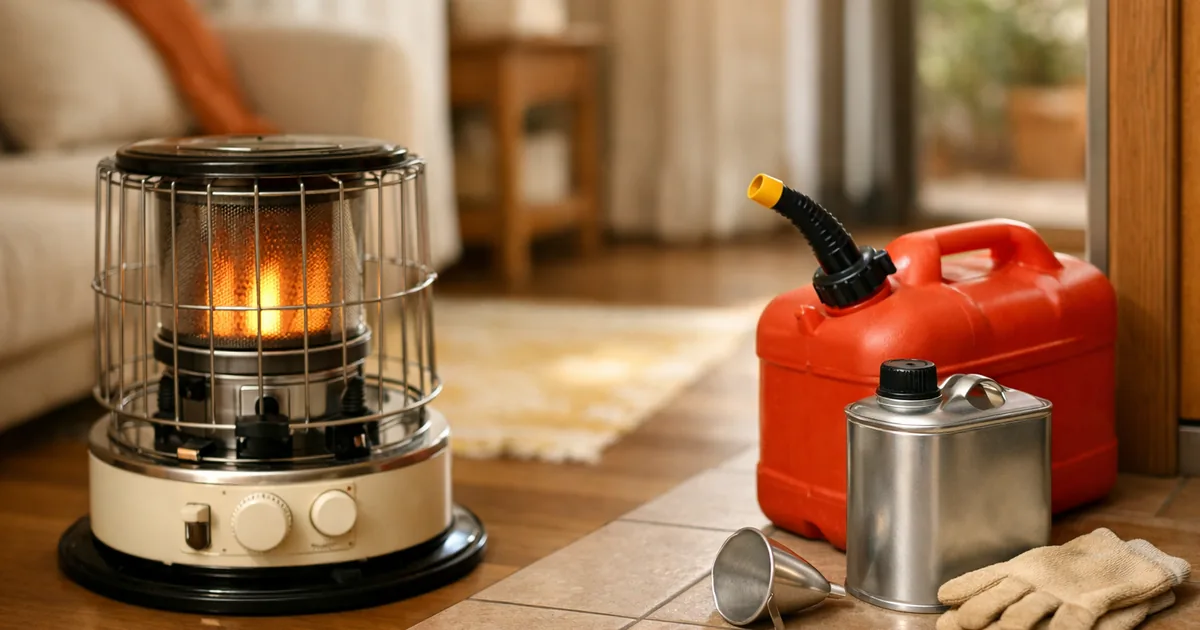
1. 1K kerosene only — never gasoline — keep kerosene in a metal can clearly marked KEROSENE, never a red can (CPSC).
2. Refuel outdoors, off and cool — do not move, service or refuel it while it is running or still hot.
3. 3 feet (about 0.9 m), ventilation, off at bedtime — away from bedding, furniture and drapes, doors open to the rest of the house, never left unattended.
The numbers — CPSC (US)
| Item | What the source says | Release |
|---|---|---|
| Kerosene heater fires | About 1,900 residential fires and about 60 deaths associated with kerosene heaters in 1987 | 29 November 1989 (90-015) |
| All supplemental heating | About 105,800 residential fires and about 600 deaths in 1987; on top of that, thousands of contact burns and about 100 carbon monoxide deaths every year | Same release |
| Portable or fixed local heaters | About 10,900 residential fires and about 190 deaths “in a recent year” | 16 December 2003 (04-054) |
| Gasoline incidents | “A number of serious injuries and deaths” recently from gasoline used in kerosene heaters | 8 March 1982 (82-006, with the National Kerosene Heater Association, NKHA) |
By our calculation, kerosene heaters were about 1.8% of the 105,800 supplemental heating fires in 1987 (1,900 ÷ 105,800) but 10% of the 600 deaths (60 ÷ 600). Per 100 fires, that is about 3.2 deaths for kerosene heaters (60 ÷ 1,900 × 100) against about 0.6 for supplemental heating as a whole (600 ÷ 105,800 × 100). These are old US estimates and do not describe Korea today.
Fuel — flare-up and gasoline mix-ups
- 1K kerosene only — a CPSC analysis of kerosene heater accidents concluded that flare-up (uncontrolled flaming) comes from several factors, including improper or contaminated fuel, and that one way to reduce the risk substantially is to use only 1K kerosene, never gasoline or non-kerosene fuels (1989).
- Gasoline burns out of control — the 1982 release quotes the NKHA president: gasoline is extremely volatile and will burn out of control in a kerosene heater. Use only water-clear kerosene.
- Container mix-ups — people usually use gasoline unknowingly because of confusion over fuel containers. Buy and store kerosene in metal containers clearly marked KEROSENE, and never use red cans: a red can or an old gasoline can could lead a service station attendant or a family member to fill it with gasoline.
- Camping fuel — do not confuse kerosene with the water-clear gasoline sold for camping stoves.
- Storage — keep kerosene out of reach of children and outside living areas.
We have not read how the grades of kerosene sold in Korea line up with the US “1K”, or Korean fuel-can colour practice. Using only the fuel your heater’s manual names is the safest rule (our note — the USFA card also says “proper fuel” only).
Checker
Short of 3 feet (91.44 cm) by: 0 cm
Results update as you type. The ten points are rules from three CPSC releases (82-006, 90-015, 04-054); splitting them into items, counting them and the shortfall (91.44 cm minus your distance, rounded to the nearest cm) are our calculation. 3 feet = 91.44 cm is our conversion. “0” only means these ten points are kept; it does not certify the heater as safe.
For example, if you burn 1K kerosene and keep every other rule but the heater stands 60 cm from the drapes and is never inspected, you have 2 of the 10 points to fix and are 31 cm short of 3 feet. Switch the fuel in the same home to “gasoline, another fuel, or not sure” and it becomes 3 of the 10 (all our calculation).
Using it — CPSC rules
- Refuel outdoors — away from flammable materials. Do not move, handle, service or refuel the heater while it is operating or still hot (1982).
- Ventilation — use it only in well-ventilated areas to eliminate the risk of asphyxiation (1982). With an unvented fuel-burning heater, keep doors open to the rest of the house to prevent pollutant build-up and promote proper combustion (2003).
- Wick — kerosene heaters emit air pollutants while running, which can build up in an enclosed room; lowering the wick below the manufacturer’s recommended setting can make it worse. Set the wick at the recommended height and make sure there is adequate ventilation before use (1989).
- Distance — at least 3 feet from combustible materials (1982). The 2003 release names bedding, drapes and furniture, and says to place the heater on a level, hard, nonflammable surface, not on rugs or carpets.
- Sleep and absence — avoid leaving it unattended and extinguish it before going to sleep (1982); never place a heater close to a sleeping person (2003).
- Children — do not let children operate or refuel heaters (1982); keep children and pets away (2003).
Choosing one and preparing the home — CPSC
- Listing — the heater should be labelled as listed with a nationally recognized testing laboratory (1982). Heaters certified to the latest standards have the newest safety features; older ones may not meet them (2003).
- Tip-over shut-off and burner guarding — CPSC says it worked to upgrade industry standards so that an automatic cut-off is now required to turn off electric or kerosene heaters if they tip over, with more guarding around the burner of kerosene heaters (2003).
- Alarms — a smoke alarm with fresh batteries on each level and inside every bedroom, and a carbon monoxide alarm outside the bedrooms in each separate sleeping area (2003).
- Yearly inspection — have gas and kerosene space heaters inspected annually (2003).
- Follow the manual — for installing, operating and maintaining the heater (1989).
The 2003 release also says mobile homes need specially designed heating equipment. Whether that carries over to campervans or container homes in Korea is not something we have judged.
Checklist
- ☐ 1K kerosene (the kerosene your manual names) only; never mix with gasoline or camping fuel
- ☐ Kerosene in a metal can marked KEROSENE, never red, out of children’s reach and outside living areas
- ☐ Refuel outdoors, off and cool
- ☐ At least 3 feet (about 0.9 m) from bedding, furniture and drapes, on a hard level surface
- ☐ Doors open; wick at the recommended height
- ☐ Off before sleeping or leaving
- ☐ Smoke and CO alarms; inspection every year
Questions that remain
Can I leave a kerosene heater on in the bedroom overnight?
The CPSC says to put it out before going to sleep and never to use a space heater overnight in the room where you sleep (1982 and 1989 releases). Fuel-burning heaters also carry carbon monoxide risk; for the symptoms and what to do, see carbon monoxide poisoning (NHS).
What if it catches fire while I refuel?
The CPSC releases we read do not say what to do if a fire starts while refuelling. Extinguisher types and how to use them are in fire extinguishers at home and in the car.
How is it different from an electric heater?
The 3 feet, switching off at bedtime and the listing mark are the same; a kerosene heater adds rules on fuel, refuelling, ventilation and the wick (our summary). The electric heater rules are in space heater safety.
Sources
- CPSC — CPSC, NKHA Warn Against Use Of Gasoline In Kerosene Heaters — source (8 March 1982, number 82-006; checked 24 November 2026). Gasoline incidents, water-clear kerosene, metal KEROSENE cans and no red cans, camping-fuel confusion, nine rules (storage, refuelling outdoors, ventilation, 3 feet, not touching it hot, listing, off at bedtime, children).
- CPSC — CPSC News Feature: Getting Ready For Cold Weather — source (29 November 1989, number 90-015/TD; checked 24 November 2026). 1987: 105,800 supplemental heating fires and 600 deaths, 1,900 kerosene heater fires and 60 deaths, flare-up and 1K kerosene, wick height and ventilation, general rules.
- CPSC — CPSC Offers Tips to Prevent Home Fires From Space Heaters — source (16 December 2003, number 04-054; checked 24 November 2026). 10,900 fires and 190 deaths, tip-over cut-off and burner guarding, distance and surface, doors open, alarms, annual inspection.
- Not read. The CPSC booklets “What You Should Know about Space Heaters” and on kerosene heaters (PDF), recent US fire statistics (NFPA, USFA), kerosene heater recall lists, Korean kerosene quality standards and grade names, Korean safety standards (KC) for oil heaters and fire agency statistics, Korea Consumer Agency incident cases, and individual product manuals.
- What we added. The checker and its sums (item count, shortfall, shares, deaths per 100 fires), the 3 feet = 91.44 cm conversion and the Korean gloss. We have not copied the media contact details or phone numbers in the releases.
Where to check further
- Your heater’s manual — the right fuel, wick height and ventilation.
- The CPSC releases — the three above.
Written on 24 November 2026. The content is from the sources; the glosses and checker are ours. If there is a fire or you suspect carbon monoxide, get outside and call 119 in Korea first.