Many people stop at the blood pressure line on a health check result and wonder whether it counts as high. The UK National Health Service (NHS) page “High blood pressure (hypertension)” opens by saying it can lead to serious problems like heart attacks or strokes, but lifestyle changes and blood pressure medicines can help you stay healthy. It adds that there are usually no symptoms, so the only way to find out is to get it checked. Below, from that page and the NHS “Blood pressure test” and “Low blood pressure” pages, are the high lines of 140/90 at a clinic and 135/85 at home, the low line of under 90/60, the 8 things that raise your risk, how to measure, and the lifestyle changes that help, with a reading checker we added.
1. 140/90 or higher checked by a healthcare professional, or 135/85 or higher at home, is usually high blood pressure — the first number (systolic) is higher than the second (diastolic).
2. Under 90/60 is low blood pressure — it does not always cause symptoms; treatment may be needed if it does.
3. Aged 40 or over and not checked for more than 5 years? Get checked at a pharmacy or GP — to lower it, aim for at least 150 minutes of exercise a week, avoid regularly drinking more than 14 units of alcohol a week, and cut the salt.
Blood pressure reading checker
| High line used | - |
| Second number against the high line | - |
| Low line (under 90/60) | - |
| What the NHS says next | - |
It updates as you type. The 140/90, 135/85 and 90/60 lines are the NHS figures. The pages write them as pairs (“140/90 or higher”, “less than 90/60”) and do not say what happens when only one number crosses, so we flag a reading when either number crosses the line (our reading). One reading is not a diagnosis — the NHS says it is confirmed with home readings over a few days, another check, or a 24-hour monitor.
The default is a home reading of 138/86. Against the home line of 135/85 the first number is 3 mmHg above and the second 1 mmHg above, so it shows “in the high range”. Switch the same reading to “by a healthcare professional” and the line becomes 140/90: the first number is 2 mmHg below, the second 4 mmHg below, and it shows “between the high and low lines” (our example). The home line being 5 lower on both numbers makes the difference.
Reading the numbers — NHS
Blood pressure is given as 2 numbers, the first higher than the second (for example, 130/80). The first is the systolic pressure, the highest level your blood pressure reaches when your heart pumps blood around the body; the second is the diastolic pressure, the lowest level when your heart relaxes between beats.
| Type | NHS line | Worth noting (our notes) |
|---|---|---|
| High (by a healthcare professional) | 140/90 or higher | Pharmacy, GP and workplace checks |
| High (at home) | 135/85 or higher | 5 lower on both numbers than the clinic line (our sum: 140−135, 90−85) |
| Low | Less than 90/60 | First line of the “Low blood pressure” page |
Both high-pressure pages say a reading is usually considered high at these lines. None of the three pages we read names a middle band such as “normal” or “raised”, so our checker just says “between the lines”.
8 things that raise your chances — NHS
- Your age — more likely as you get older
- Close relatives with high blood pressure
- Your ethnicity — higher risk with a Black African, Black Caribbean or South Asian background
- An unhealthy diet — especially one high in salt
- Being overweight
- Smoking
- Drinking too much alcohol
- Feeling stressed over a long period
The NHS says high blood pressure is very common, especially in older adults. Of the 8, age, family and ethnicity cannot be changed; the other five are lifestyle (our grouping).
Symptoms and when to get help — NHS
| Where | When | Worth noting (our notes) |
|---|---|---|
| Pharmacy or GP check | You think you might have it or be at risk · you're aged 40 or over and have not had it checked for more than 5 years | Some pharmacies may charge; many offer free checks for people aged 40 or over (in the UK) |
| 111 | You often have headaches or blurred vision · chest pain that comes and goes · other symptoms you're worried could be caused by high blood pressure | The page says high blood pressure can rarely cause headaches, blurred vision or chest pain |
| 999 | Sudden chest pain or discomfort that does not go away · pain spreading to the arm, neck, jaw, stomach or back · chest pain with feeling sweaty, sick, light-headed or short of breath | The 3 signs of a possible heart attack. Do not drive yourself to A&E |
The NHS says high blood pressure does not usually cause any symptoms and many people have it without realising. The 3 signs for 999 and the other causes of chest pain are in chest pain (NHS). In Korea, read 999 as 119 (our reading).
Where and how to measure — NHS
- Where — most pharmacies, your GP surgery, some workplaces.
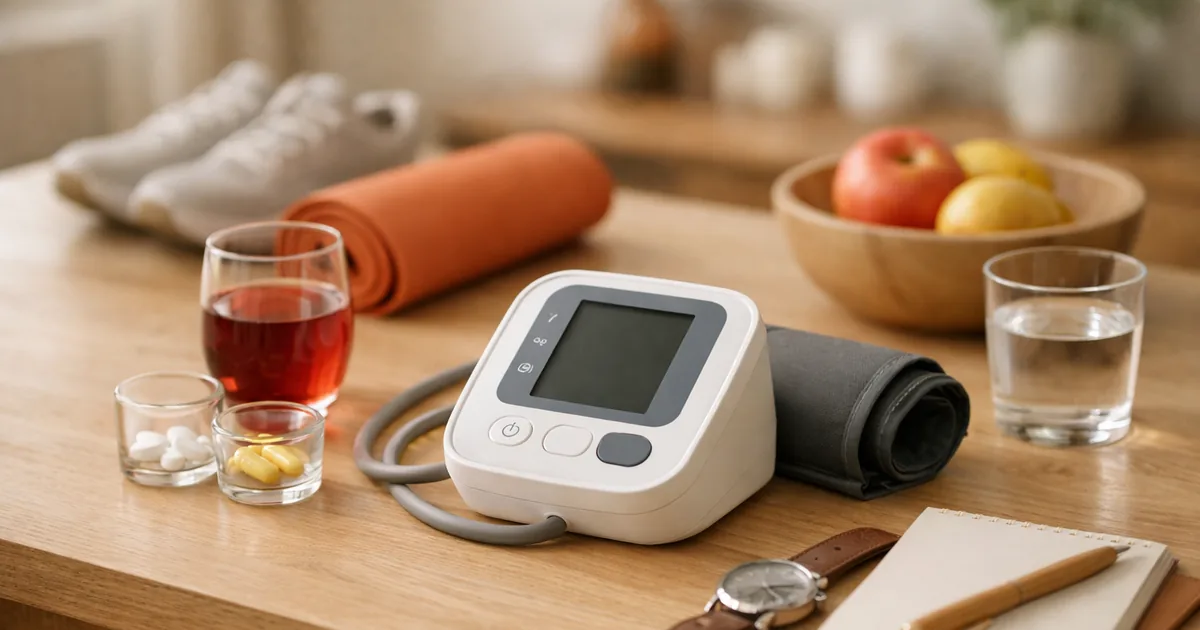
- How long — usually a couple of minutes. Sit down, roll up your sleeve, rest your outstretched arm on a table and relax, and stay still while the cuff on your upper arm fills with air and releases. It may be done a couple of times for accuracy.
- At home — take a reading, note the numbers, wait 1 minute and do it again. You usually do this 2 times, once in the morning and once in the evening; your doctor or nurse says for how many days.
- 24 hours — a monitor fitted at a surgery or hospital, worn at home and returned the next day; it will not affect your daily activities.
- Confirming — after a high reading you may be asked to check at home over a few days, come back days or weeks later, or wear a 24-hour monitor.
- How often — if you're 40 to 74, at least once every 5 years as part of the NHS Health Check.
It is particularly important to get checked if you're 40 or over, from a Black or South Asian background, have close relatives with high blood pressure, smoke, drink too much alcohol or caffeine or eat too much salt, or are living with obesity.
If it is not treated — NHS
Too-high blood pressure puts extra strain on your blood vessels, heart and organs such as your brain, kidneys and eyes. Untreated, it raises the risk of 6 serious conditions:
- Heart disease
- Heart attacks
- Strokes
- Heart failure
- Kidney disease
- Vascular dementia
The NHS adds that lowering your blood pressure even a small amount can help reduce the risk. Stroke signs are in stroke warning signs.
Lifestyle changes that help — NHS
| Type | What the NHS says | Our guides |
|---|---|---|
| Do | Have a healthy, balanced diet | — |
| Do | Exercise regularly — aim for at least 150 minutes a week | weekly exercise plan |
| Do | Lose weight if you're overweight | — |
| Don't | Eat too much salt — avoid salty food or adding salt to meals | salt and sodium (WHO) |
| Don't | Drink too much alcohol — avoid regularly drinking more than 14 units a week | alcohol units (NHS) |
| Don't | Drink too much caffeine — coffee, tea and cola | — |
| Don't | Smoke | — |
That is 3 dos and 4 don'ts. The page gives no grams of salt or cups of coffee. How many drinks 14 units is can be worked out in the alcohol units guide.
Medicines — NHS
- A GP will usually prescribe medicine if your blood pressure is very high, you're at higher risk of problems such as a heart attack or stroke, or it is still high after healthy lifestyle changes.
- There are lots of different medicines; which one depends on things like how high it is, your age and your ethnicity.
- Most are tablets taken once a day. You may need more than 1 medicine to keep it under control.
Low blood pressure — NHS
The NHS defines low blood pressure as a reading of less than 90/60mmHg. It does not always cause symptoms, but you may need treatment if it does. Get it checked if you keep getting lightheadedness or dizziness, feeling sick, blurred vision, generally feeling weak, confusion or fainting; if symptoms come when you stand up or change position suddenly, it may be postural hypotension.
- Do: get up slowly from sitting · move slowly from lying to sitting to standing when getting out of bed · eat small, frequent meals (lying down or sitting still for a while after eating may also help) · drink more water
- Don't: sit or stand for long periods · bend down or change posture suddenly · drink too much alcohol
- Causes: you may be fit and healthy or have inherited it; some people develop it as they get older. Pregnancy, some conditions such as diabetes, and some medicines can cause it.
- Treatment: if a cause is found a GP may change medicines or the dose, or suggest support stockings. Medicine to raise blood pressure is rarely needed.
Dizziness on standing also comes up with dehydration; that rule is in dehydration symptoms (NHS).
Checklist
- ☐ 140/90 or higher at a clinic, 135/85 or higher at home — look at both numbers
- ☐ At home, 2 readings 1 minute apart, morning and evening
- ☐ 40 or over and not checked for more than 5 years: get checked at a pharmacy or clinic
- ☐ At least 150 minutes of exercise a week, no more than 14 units a week, less salt, caffeine and smoking
- ☐ Under 90/60 with dizziness or fainting that keeps happening: a GP (a local clinic)
- ☐ Sudden chest pain that won't go: 999 straight away (in Korea, 119)
Questions that remain
Is 130/80 normal?
The pages we read use 130/80 only as an example of how readings are written and do not call it “normal”. All we can say is that it is below the high line of 140/90 (135/85 at home) and above the low line of 90/60.
Is it high blood pressure if only one number is high?
The pages say “140/90 or higher” and do not cover only the first or only the second number crossing. Our checker flags it as high if either crosses, but that is our reading; ask a healthcare professional to confirm.
Are the Korean lines the same?
We have set out the NHS lines only. We did not read Korean society or national health check lines, and have not filled them in.
Sources
- NHS — High blood pressure (hypertension) — page (page shows: reviewed 19 July 2024, next review 19 July 2027; checked 26 November 2026). The 8 risks, when to get checked, symptoms and 111 and 999, confirming, 140/90 and 135/85, the 6 conditions, lifestyle, medicines.
- NHS — Blood pressure test — page (page shows: reviewed 25 November 2025, next review 25 November 2028; checked 26 November 2026). Why it is done, who should get checked, where and how, home readings (2, 1 minute apart, morning and evening), 24-hour monitors, systolic and diastolic.
- NHS — Low blood pressure (hypotension) — page (page shows: reviewed 11 July 2023, next review 11 July 2026 — unchanged when checked on 26 November 2026). Under 90/60, 6 symptoms, postural hypotension, every 5 years at 40 to 74, treatment, dos and don'ts, causes.
- Not read. The NHS “Check your blood pressure reading” tool and its chart, Blood Pressure UK and British Heart Foundation pages (choosing a monitor, the diary), the NHS medicines pages and drug names, high blood pressure in pregnancy, and Korean lines (Korean Society of Hypertension, national health checks) and free checks in Korea.
- What we added. The reading checker and its “either number” reading, the difference-of-5 sum, the grouping of the 8 risks, the “worth noting” and “our guides” columns, and the 119 reading.
Where else to check
- A local clinic or pharmacy — a repeat reading, and how to use a home monitor.
- Your national health check result — the verdict on Korean lines.
- 119 — if you have the 999 chest pain signs.
Written 26 November 2026. The content sets out the NHS pages; the notes are ours. It does not replace diagnosis or treatment.