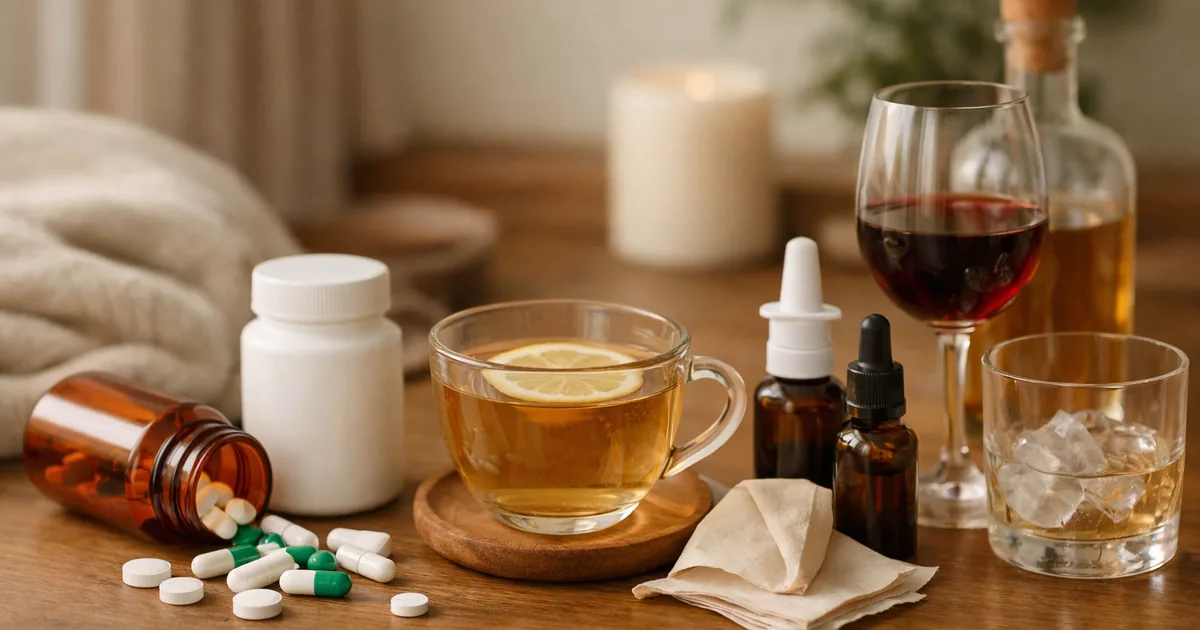
Antibiotics, in the words of the UK National Health Service (NHS), are medicines used “to treat or prevent some types of bacterial infection”. On the same page the NHS says they do not work for viral infections such as colds, flu and most coughs, and are no longer routinely used for chest infections, ear infections in children or sore throats. Starting a course does not make you non-infectious straight away: depending on the infection and treatment it can take between 48 hours and 14 days. If you miss a dose, take it when you remember unless the next one is almost due, and never take a double dose. With metronidazole, avoid alcohol for 48 hours after finishing; with tinidazole, 72 hours. We added a checker that turns these rules into dates.
1. They do not work for colds, flu or most coughs — and are no longer routinely used for chest infections, children’s ear infections or sore throats.
2. You can stay infectious for 48 hours to 14 days after starting — missed dose: take it when you remember, skip it if the next is almost due, never double up.
3. No alcohol for 48 hours after metronidazole, 72 hours after tinidazole — a blistering or peeling rash, wheezing, a tight chest or throat, or a swollen face, lips or tongue: call 999 (119 in Korea).
Checker
48 hours falls on: - · 14 days falls on: -
Results update as you type. The illness groups copy the wording of the NHS Antibiotics, Uses and Antibiotic resistance pages and do not replace a prescription. “48 hours to 14 days” means the end of the infectious period falls somewhere in that range, so the dates simply add 2 and 14 days to the start (our sums) — ask a GP or pharmacist when you stop being infectious. The alcohol time adds the Interactions page’s 48 hours (metronidazole) or 72 hours (tinidazole) to the last day (our sum).
For example, choose common cold and the checker shows “viral — antibiotics do not work”. If you started on 16 November 2026, 48 hours falls on 18 November and 14 days on 30 November (our sums). Finish metronidazole on 22 November and avoid alcohol for a further 48 hours, to 24 November. With tinidazole it is 72 hours, to 25 November.
When they are and are not used — NHS
| Group | What the NHS says | Examples (NHS) |
|---|---|---|
| Do not work | Viral infections | Colds, flu, most coughs |
| No longer routinely used | Many mild infections clear up on their own | Chest infections, ear infections in children, sore throats |
| Not serious, but unlikely to clear without them | May be prescribed | Acne |
| Not serious, but could spread if not treated promptly | May be prescribed | Impetigo, chlamydia |
| Evidence they could significantly speed recovery | May be prescribed | Kidney infection |
| Risk of more serious complications | May be prescribed | Cellulitis, pneumonia |
The NHS Uses page lists people at higher risk of infection who may be offered antibiotics: those aged over 75, babies under 72 hours old with a bacterial infection or a higher than average risk of one, people with heart failure, people who take insulin for diabetes, and people with a weakened immune system from a condition or a treatment such as chemotherapy. Antibiotics given to prevent infection (prophylaxis) cover operations with a high infection risk (some cataract or glaucoma surgery, joint replacement, pacemaker surgery, gallbladder or appendix removal and others), animal or human bites and wounds in contact with soil or faeces, and people without a spleen, on chemotherapy or with sickle cell anaemia.
How to take them — missed and extra doses
| Situation | NHS advice | Worth noting (our reading) |
|---|---|---|
| Missed a dose | In most cases take it as soon as you remember; if it is almost time for the next dose, skip the missed one and carry on as normal | Check the leaflet first |
| Double dose | Do not take a double dose to make up for a missed one | — |
| One extra by mistake | Two doses closer together than recommended raise the risk of side effects, but 1 extra dose is unlikely to cause serious harm. More than 1 extra, worried, or severe side effects: GP or NHS 111 | In Korea, the prescribing clinic or a pharmacy |
| Still infectious | You may still be infectious after starting — 48 hours to 14 days depending on the infection and treatment | The checker’s 2- and 14-day dates |
| Someone else’s | Never take antibiotics prescribed for someone else | — |
Most come as tablets, capsules or liquid; creams, lotions, sprays and drops are used for skin, eye or ear infections, and injections or drips for serious infections. Some must be taken with food and some on an empty stomach, so read the leaflet.
Alcohol, the pill and other medicines — NHS
| Antibiotic | NHS advice | Worth noting (our reading) |
|---|---|---|
| Common antibiotics | Drinking in moderation is unlikely to cause problems; avoiding alcohol while on medicine or unwell is generally sensible, and alcohol can worsen side effects such as nausea or dizziness | Checker shows 0 hours |
| Metronidazole | No alcohol during the course and for 48 hours after. Vomiting, stomach pain, hot flushes, a fast or irregular heartbeat, headaches, dizziness, drowsiness | Used for dental and vaginal infections, skin infections, leg ulcers, pressure sores |
| Tinidazole | No alcohol during the course and for 72 hours after | Also helps clear H. pylori |
| Linezolid | Can be affected by fermented drinks such as wine, beer, sherry and lager — may be best avoided | No time given |
| Doxycycline | Alcohol can affect it, and it may work less well in people with a history of heavy drinking | No time given |
| Rifampicin, rifabutin | Can make the combined contraceptive pill less effective — you may need extra contraception such as condoms during treatment | Ask a GP, nurse or pharmacist |
Tell your doctor about all medicines and herbal remedies you take. Tetracyclines can make skin sensitive to sunlight and artificial light such as sunlamps and sunbeds.
Side effects and emergencies — NHS
- Common: diarrhoea and feeling sick — usually mild and gone once the course ends.
- Allergic reactions: rare, and more likely with penicillins and cephalosporins — an itchy raised rash (hives), coughing, wheezing, a tight throat; mild to moderate reactions can usually be treated with antihistamines.
- Call 999 or go to A&E: a rash that may be itchy, red, swollen, blistered or peeling; wheezing; a tight chest or throat; trouble breathing or talking; a swollen mouth, face, lips, tongue or throat (119 in Korea — our addition).
- Fluoroquinolones: very rarely, long-lasting or permanent effects on joints, muscles and nerves. Stop and see a GP straight away for tendon, muscle or joint pain (usually knee, elbow or shoulder) or tingling and numbness, and for swollen ankles, feet or legs, new palpitations or sudden breathlessness.
The NHS says that using antibiotics for minor conditions makes them more likely to fail against serious infections. It names MRSA, Clostridium difficile (C. diff) and the bacteria behind multi-drug-resistant tuberculosis as “superbugs”, an increasing cause of disability and death around the world (no figures given).
Whether a cold or cough needs a GP can be counted with the checker in respiratory tract infections (RTIs) NHS.
Checklist
- ☐ Colds, flu and most coughs: don’t expect antibiotics
- ☐ If prescribed, follow the leaflet — with food or on an empty stomach
- ☐ Missed dose: when you remember, skip if the next is near, never double
- ☐ Still infectious for 48 hours to 14 days after starting — check with a GP or pharmacist
- ☐ No alcohol for 48 hours after metronidazole, 72 after tinidazole; extra contraception with rifampicin
- ☐ Blistering or peeling rash, tight throat or chest, swollen face or lips: emergency
Questions that remain
How many days should a course last?
The NHS pages give no course lengths by illness — the advice to finish the course as prescribed even if you feel better is on the RTIs page.
How close is “almost time for the next dose”?
The page gives no number of hours. Ask a pharmacist or check the leaflet.
Is prescribing the same in Korea?
This post sets out the NHS pages; we did not read Korean prescribing guidance or statistics this time.
Sources
- NHS — Antibiotics (Overview) — source (page reviewed 11 November 2022, next review due 11 November 2025; checked 16 November 2026). What they do not treat, what they are no longer routinely used for, 48 hours to 14 days, how to take them, missed and extra doses, forms, types.
- NHS — Antibiotics: Uses — source (same review date). The four reasons to prescribe and examples, people at higher risk (over 75, 72 hours), prophylaxis.
- NHS — Antibiotics: Side effects, Interactions, Antibiotic resistance — side effects, interactions, resistance (all reviewed 11 November 2022). Allergy and 999, tetracyclines and fluoroquinolones, alcohol 48 and 72 hours, linezolid and doxycycline, the pill, superbugs.
- Worth knowing. All four pages show a “next review due 11 November 2025” date that has passed (still the case when checked on 16 November 2026). The Uses page lists genital herpes, a viral condition, among recurring infections; we left it as written and kept it out of the checker list.
- Not read. The NHS pages for individual antibiotics (amoxicillin, metronidazole and others), MHRA Yellow Card and safety notices, NICE antimicrobial prescribing guidance, Korean prescribing guidance and resistance data, and antibiotics in pregnancy or breastfeeding (not on the interactions page).
- What we added. The “worth noting” column, the checker’s illness grouping and its 2-day, 14-day, 48-hour and 72-hour date sums, and the Korea 119 note.
Where to check further
- A pharmacist — missed doses, food, and mixing with other medicines.
- The prescribing clinic — side effects, and when you stop being infectious.
Written on 16 November 2026. The content is from the NHS; the glosses and sums are ours.