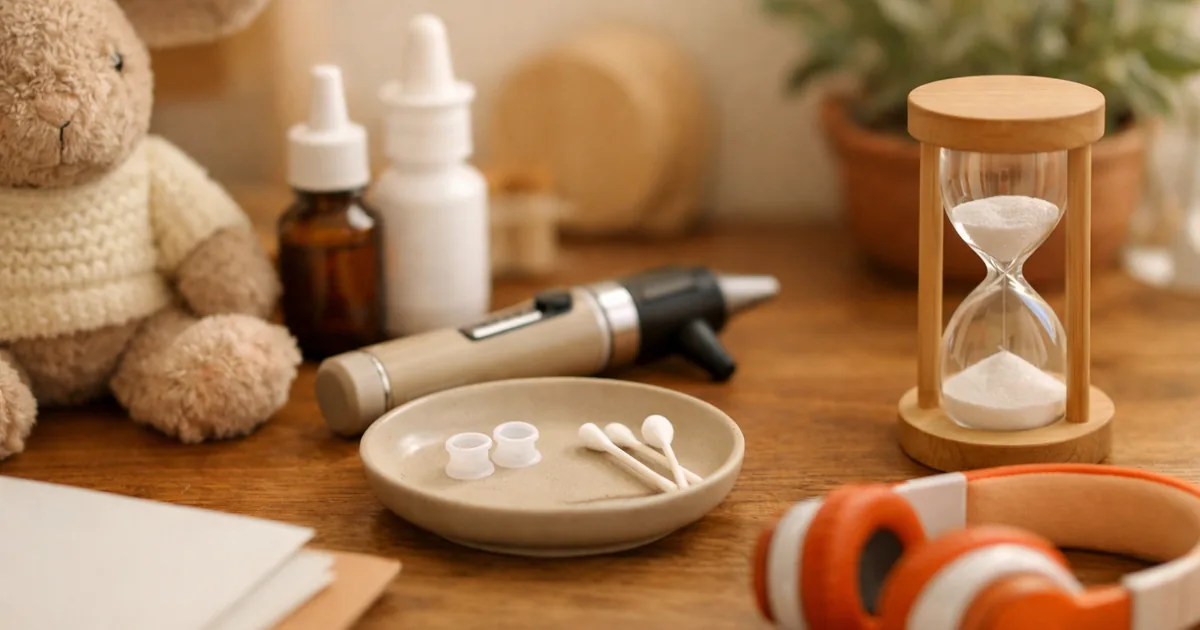
A child who keeps asking for the TV to be turned up, doesn’t answer when called, or asks people to repeat themselves may have glue ear. The UK National Health Service (NHS) describes glue ear as the middle part of the ear canal filling up with fluid, which can cause temporary hearing loss. It usually clears up within 3 months, but see a GP about any hearing problems. There is no effective medicine, so a GP usually waits to see, and a child may be monitored for up to a year. In hospital the options are hearing aids or grommets, which should fall out by themselves within 6 to 12 months. Here is the NHS page, with a date calculator.
1. The most common symptom is temporary hearing loss — it can affect both ears at once.
2. No effective medicine, so it is usually watched — it often clears within 3 months, with monitoring for up to a year.
3. Hospital if learning or development is affected — temporary hearing aids or grommets, which fall out within 6 to 12 months.
Symptoms — NHS
| Type | What the NHS says | Worth noting (ours) |
|---|---|---|
| Most common | Temporary hearing loss — can affect both ears at once | — |
| Ear | Earache or ear pain | Ear pain in general: earache |
| Sounds | Ringing or buzzing (tinnitus) | See tinnitus |
| Balance | Problems with balance | — |
| If it lasts | Can affect a child’s speech development and progress at school | Hence watching for hearing signs early (ours) |
Glue ear is much more common in children, but adults with it have the same symptoms, says the NHS.
See a GP if your child shows hearing signs — NHS
The NHS says to see a GP (non-urgent) if your child has signs of a hearing problem, such as:
| Type | What the NHS says | Worth noting (ours) |
|---|---|---|
| Speech | Speaking loudly, being difficult to understand | — |
| Repeating | Asking people to repeat what they say | — |
| Volume | Asking for the TV or music to be turned up loud | — |
| Distance | Struggling to hear people far away | — |
| Attention | Becoming easily distracted when people are talking | — |
| Tiredness | Finding it hard to concentrate, or seeming tired and irritable because listening is harder | — |
At the appointment — NHS
A GP should be able to tell if it’s glue ear by looking for fluid inside the ear, using a small scope with a light and magnifying glass; it should not be painful. If your child has had glue ear for more than 3 months, they may be referred to a specialist for hearing tests, which find out how severe any hearing loss is and what’s causing it.
GP treatment — NHS
| Type | What the NHS says | Worth noting (ours) |
|---|---|---|
| Waiting | Glue ear is not always treated; the GP usually waits to see if it gets better | — |
| Why | There’s no effective medicine, and it often clears within 3 months | — |
| Monitoring | A child may be monitored for up to a year in case symptoms change or worsen | See the date calculator |
| Autoinflation | Helps fluid drain — blowing up a special balloon using 1 nostril at a time, or swallowing with the nostrils held closed | Done several times a day, so not usually for under 3s |
| Antibiotics | May be prescribed if glue ear causes an ear infection | See ear infections |
Hospital treatment — NHS
| Type | What the NHS says | Worth noting (ours) |
|---|---|---|
| Referral | Symptoms affecting learning and development; severe hearing loss before glue ear; Down’s syndrome or a cleft lip and palate (less likely to clear by itself) | Any one of the three |
| 2 main treatments | Temporary hearing aids or grommets (small tubes in the ear) | — |
| Occasionally | Surgery to remove glands at the back of the nose (adenoids) — an adenoidectomy | — |
| Grommets | A small tube placed during surgery; drains fluid and keeps the eardrum open; should fall out naturally within 6 to 12 months as the ear gets better | — |
The hospital specialist helps you decide the best option, says the NHS. It also points to an NHS England decision support tool (PDF) and the National Deaf Children’s Society (NDCS), which we did not read this time.
Date calculator
Enter when symptoms were first noticed to see the 3-month and 1-year dates, and a grommet surgery date for the 6 to 12 month window. For example, a start on 2026-10-29 gives 2027-01-29 at 3 months and 2027-10-29 at a year; grommets on 2027-02-01 give 2027-08-01 ~ 2028-02-01 (our example).
Updates as you type. A month is counted to the same date, or the month’s last day if that date doesn’t exist (our method). The NHS figures are “usually” and “up to”, so these dates are a guide, not a schedule.
Checklist
- ☐ More TV-turning-up or asking people to repeat?
- ☐ Then see a GP (in Korea, ENT or a paediatrician)
- ☐ Going on more than 3 months? Ask about a hearing-test referral
- ☐ Aged 3 or over? Ask about autoinflation
- ☐ After grommets, watch for them falling out within 6 to 12 months
Questions that remain
What causes it?
The page text does not give causes. It mentions a video that explains them, which we did not watch.
Is it the same as an ear infection?
The NHS describes glue ear as fluid in the middle ear and covers ear infections separately; antibiotics may be used if glue ear causes an infection. See ear infections and earwax.
Sources
- NHS — Glue ear — source (page shows: reviewed 5 June 2023, next review due 5 June 2026 (past at the time we checked); the video on the page reviewed 1 April 2024; checked 29 October 2026). Definition; four symptoms and the effect on speech and school; adults; seven hearing signs for a GP; examination and hearing tests after 3 months; waiting (3 months, up to a year); two autoinflation methods and under-3s; antibiotics; three referral criteria; hearing aids, grommets, adenoidectomy; grommets out in 6 to 12 months.
- Not read. The NHS England decision tool (PDF), NDCS material, the explainer video, Korean guidance.
- What we added. The “worth noting” column and the Korean care gloss.
Where to check further
- An ENT clinic or paediatrician — if you see hearing signs.
- Infant health check-ups — hearing and speech development.
Written on 29 October 2026. The content is from the NHS; the glosses are ours.