What should you do if you smell gas at home? The UK Health and Safety Executive (HSE) says that if you smell gas, or suspect a gas escape or a carbon monoxide leak, you should immediately open all doors and windows, shut off the gas supply at the meter control valve if you know where it is, and if gas keeps escaping call the gas emergency freephone number. It is illegal for anyone to use a gas appliance they suspect is unsafe: turn it off and don’t touch it until a Gas Safe registered engineer has checked it. The HSE says around 7 people die every year from gas-related carbon monoxide poisoning, and advises a safety check on appliances and flues at least once every 12 months. Here are the HSE domestic gas FAQs and its leaflet INDG238, with a calculator that works out how long you have until the next check from the months since the last one.
1. If you smell gas: open all doors and windows → shut off at the meter control valve → call the gas emergency line if it keeps escaping — HSE.
2. Turn off a suspect appliance and leave it alone — investigations and repairs by a Gas Safe registered engineer only.
3. Check gas appliances at least every 12 months; a CO alarm is a back-up — not a substitute for checks.
If you smell gas — HSE
| Step | HSE wording | Worth noting (ours) |
|---|---|---|
| 1. Ventilate | Open all doors and windows | INDG238 says “immediately” |
| 2. Shut off | shut off the gas supply at the meter control valve (if you know where it is) | worth finding the valve before you need it |
| 3. Call | if gas continues to escape, call National Grid on the Gas Emergency Freephone Number | we have not copied the number — see the source; in Korea, your city gas or LPG supplier’s emergency line (not in these sources) |
| 4. The appliance | turn it off and do not touch it until a registered engineer has checked it | “It is illegal for anyone to use a gas appliance if they suspect it is unsafe” (UK) |
| 5. Repairs | investigations and repairs by a Gas Safe registered engineer | registered engineers carry an ID card listing the appliances they can work on |
These three steps (ventilate, shut off, call) are all the two HSE sources list for when you smell gas. Neither page we read says anything about light switches, naked flames or smoking, so we have not added that.
Smelling gas is not the same as carbon monoxide
A gas smell signals escaping gas; carbon monoxide is a different problem from an appliance that isn’t burning properly. The NHS says carbon monoxide has no smell or colour — so no smell is no reassurance (our gloss). For a suspected CO leak the HSE gives the same steps as for gas (open doors and windows, shut off at the meter control valve, call) and says to switch the appliance off.
| Topic | HSE wording | Worth noting (ours) |
|---|---|---|
| CO symptoms | tiredness, drowsiness, headache, nausea, chest pains and stomach pains (INDG238); headaches or dizziness, breathlessness, nausea, loss of consciousness, tiredness (FAQs) | the HSE says they can be confused with flu or simple tiredness |
| If you have symptoms | if you believe CO may be involved, seek urgent medical advice (your GP or A&E) | — |
| Signs of a faulty appliance | yellow or orange rather than blue flames, soot or stains around the appliance, pilot lights which frequently blow out | the FAQs call yellow flames a sign of incomplete combustion |
| Ventilation | never cover an appliance or block convection air vents, fixed ventilation grilles, air bricks or outside flues | cabinet LPG heaters need a well-ventilated room; outdoor heaters are not for indoor use (FAQs, LPG section) |
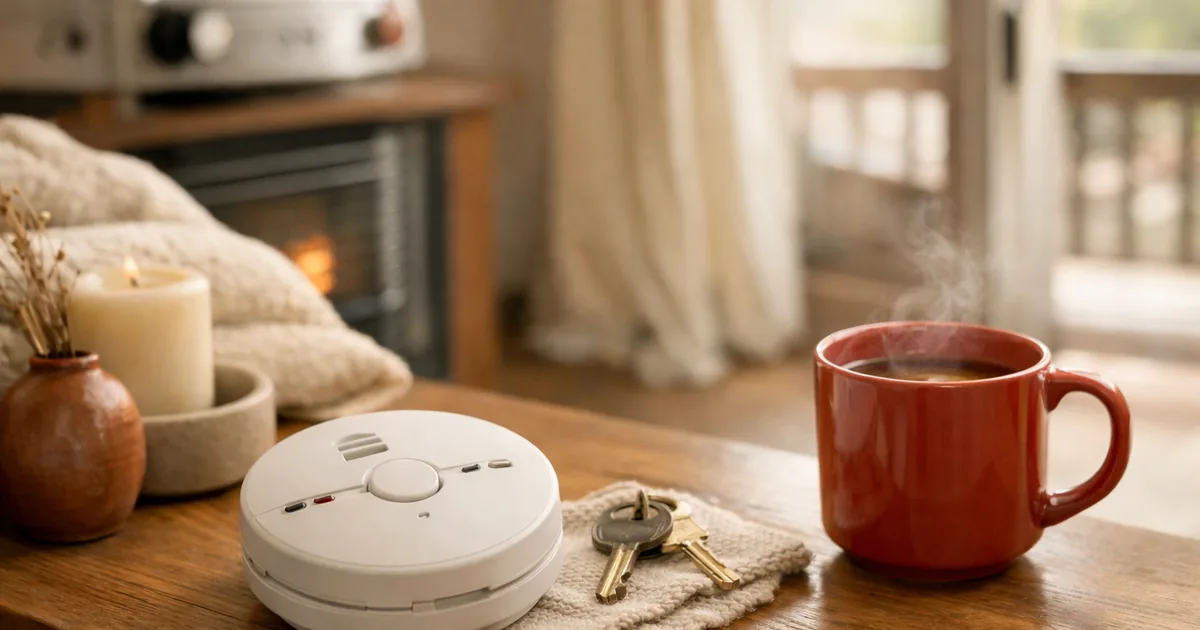
| Alarms | a useful back-up but not a substitute for regular maintenance and safety checks — BS EN 50291, Kitemark, follow the maker’s siting instructions | Korea’s alarm rules are in our CO alarm notice post |
Calculator
Months past 12: - · Days left to give tenants a copy: -
Updates as you type. “Until the next check” is 12 minus the months (never below 0), “months past 12” is the months minus 12, and the copy deadline is 28 minus the days since the check — our sums. The 12 months (HSE: at least every 12 months), 28 days, 2-year record and 2-month early window come from the HSE FAQs; the 28 days, 2 years and 2 months are UK landlord rules. It counts in whole months only, so take the exact due date from your safety record.
For example, 11 months after the last check leaves 1 month to go, and a landlord is inside the 2-month window and may have the check done now. Twenty days after the check, the copy for tenants is due in 8 days. At 14 months you are 2 months past the 12-month mark (all our sums).
How often, and what landlords must do — HSE
| Who | HSE wording | Number |
|---|---|---|
| Every gas user | installed, regularly maintained and serviced at least annually by a registered engineer — appliances and flues checked for safety at least once every 12 months | 12 months |
| Landlord — the check | an annual gas safety check; for a new appliance within 12 months of installation | 12 months |
| Landlord — doing it early | the annual check on each appliance or flue can be done up to 2 months before the date | 2 months |
| Landlord — records | keep the record for 2 years; give a copy to each existing tenant within 28 days of the check | 2 years · 28 days |
| Landlord — alarms | from 1 October 2022 relevant landlords in England must provide a carbon monoxide alarm | — |
| Landlord — no access | HSE inspectors look for at least three attempts to complete the check | 3 |
Even for people who say they can’t afford servicing, the HSE’s answer is the same: around 7 people die every year from gas-related carbon monoxide poisoning, so have appliances and flues checked at least once every 12 months. Inspection intervals for gas installations in Korea are set under its City Gas and LPG laws and differ from these UK figures (not read this time).
Checklist
- ☐ Find your meter control valve before you need it
- ☐ Smell gas: open doors and windows → shut off at the valve → call if it keeps escaping
- ☐ Yellow or orange flames, soot, or a pilot light that keeps going out: stop using it
- ☐ Never block vents, grilles, air bricks or flues
- ☐ Check appliances at least every 12 months; an alarm comes on top of that
Questions that remain
Who do I call in Korea?
The HSE material is for the UK, so it has no Korean contacts. Note your city gas company’s or LPG supplier’s emergency line from the meter or your bill in advance (our gloss — Korean laws and agency guidance were not read this time).
If I have a CO alarm, can I skip the safety check?
No. Both HSE sources call alarms a useful back-up and say they must not be regarded as a substitute for regular maintenance and safety checks.
To work out a gas bill, see the city gas bill calculator.
Sources
- HSE — Domestic gas: frequently asked questions — source (updated 16 March 2023; checked 18 November 2026). What to do about a suspect appliance or a smell, CO symptoms, alarms, the 12-month check, around 7 deaths a year, landlord duties (12 months, 2 months, 2 years, 28 days, three attempts, alarms from 1 October 2022).
- HSE — Gas appliances. Get them checked. Keep them safe. (INDG238 rev3) — source (revised 03/09, published 09/11; checked 18 November 2026). Immediate steps if you smell gas, symptoms, signs of a faulty appliance, ventilation, BS EN 50291 and Kitemark alarms.
- Not read. The Gas Safety (Installation and Use) Regulations themselves, Gas Safe Register guidance, Korea’s City Gas Business Act and LPG Safety Act rules on inspections and emergencies, Korea Gas Safety Corporation guidance, and US PHMSA material.
- What we added. The calculator and its sums, the “worth noting” column and the Korean gloss.
Where to check further
- Your gas supplier — emergency contacts and inspection schedule.
- The appliance manual — ventilation and installation requirements.
Written on 18 November 2026. The content is from the source; the glosses and calculator are ours.