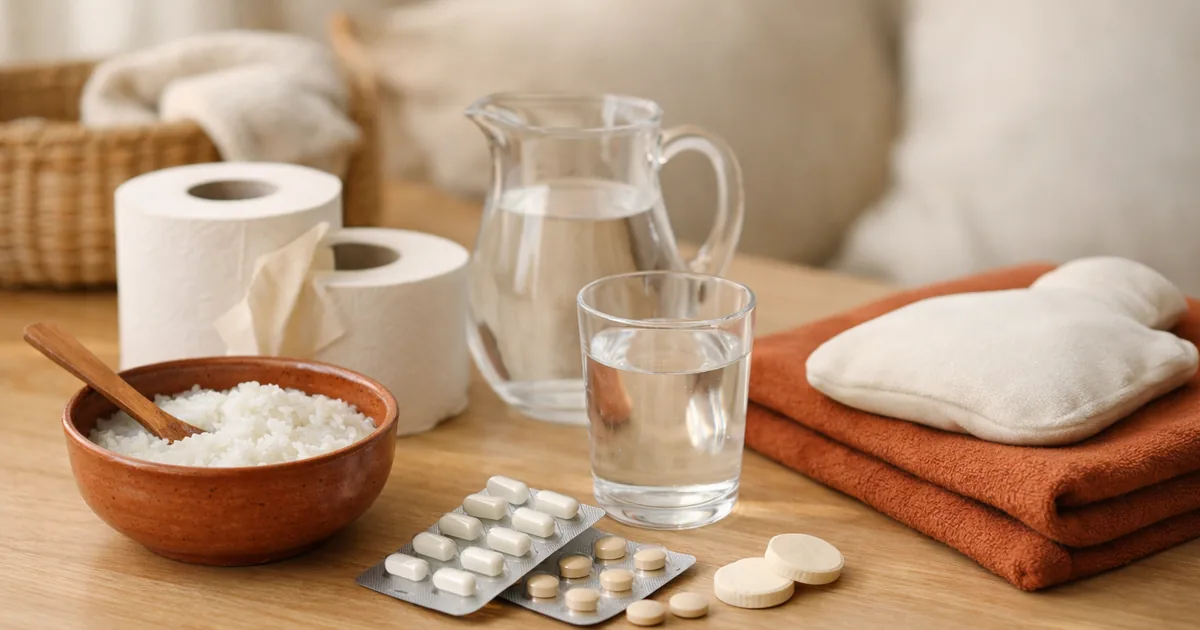
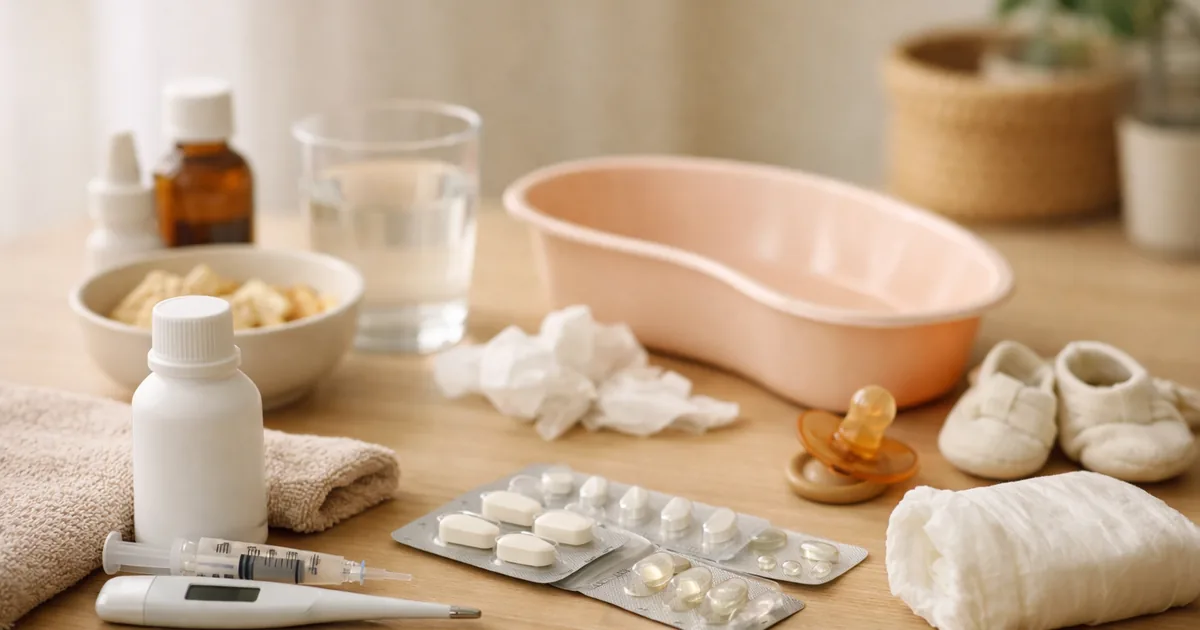
With year-end gatherings and plenty of leftovers, “was it something I ate?” stomach upsets are common this time of year. The UK National Health Service (NHS) page “Food poisoning” says it is rarely serious and usually gets better within a week, and that you can normally treat yourself or your child at home. Below are the 5 symptoms and when they start, what to do and not do at home, when to see a pharmacist, when to use 111 (urgent advice) or 999 (emergency), and the causes — with a date calculator we added that counts which day the 111 rules are reached. The page was reviewed on 19 December 2024. Handling food safely (clean, separate, cook, chill) is in our separate food safety 4 steps guide; this one is about what to do once you are ill.
1. 5 symptoms — feeling or being sick, diarrhoea, tummy pain, a high temperature, feeling generally unwell. They usually start within a few hours or days of eating, and sometimes not for a few weeks.
2. Usually better within a week — the most important thing is lots of fluids to avoid dehydration. Avoid fruit juice and fizzy drinks.
3. Diarrhoea over 7 days or vomiting over 2 days: 111. Vomiting blood, vomit like ground coffee or green vomit: 999 — if vomiting began on the night of the 21st, still vomiting on the 23rd is “over 2 days” (our arithmetic).
Food poisoning date calculator
| Vomiting becomes “over 2 days” (day 3) | - |
| Diarrhoea becomes “over 7 days” (day 8) | - |
| If it is still going that day | - |
Updates as you type. NHS: usually better within a week; call 111 for diarrhoea for more than 7 days or vomiting for more than 2. Counting the start date as day 1, so that vomiting passes 2 days on day 3 (start + 2 days) and diarrhoea passes 7 days on day 8 (start + 7 days), and reading a week as 7 days, is our arithmetic. The 999 signs — vomiting blood, green vomit, a sudden severe tummy ache and the rest — mean 999 straight away, whatever the date.
For example, if vomiting began on the night of 21 November and diarrhoea the next day, vomiting reaches the 111 rule if it is still going on 23 November (day 3), and diarrhoea if it is still going on 29 November (day 8). Usually it is better by 28 November (a week) (our arithmetic).
Symptoms and when they start — NHS
| What | What the NHS says | Worth noting (our reading) |
|---|---|---|
| Symptoms (5) | Feeling sick or being sick · diarrhoea · tummy pain · a high temperature · feeling generally unwell | The same as a stomach bug — the difference is that food is the cause |
| Start | Usually within a few hours or a few days of eating the food that caused it | Suspecting only the last meal can miss it (our reading) |
| Late start | Sometimes symptoms do not start for a few weeks | The page does not say which germs come late |
| Getting better | Usually within a week | — |
Do and don’t at home — NHS
The NHS says diarrhoea and vomiting can usually be treated at home, and that the most important thing is to have lots of fluids to avoid dehydration.
| What | What the NHS says | Worth noting (our reading) |
|---|---|---|
| Do | Stay at home and get plenty of rest | — |
| Do | Drink lots of fluids, such as water or squash — small sips if you feel sick | — |
| Do | Carry on breast or bottle feeding — if a baby is being sick, small feeds more often | — |
| Do | Give babies on formula or solid foods small sips of water between feeds | — |
| Do | Eat when you feel able to — avoiding fatty or spicy foods may help | There is no “don’t eat” advice |
| Do | Take paracetamol if in discomfort — check the leaflet before giving it to a child | — |
| Don’t | Fruit juice or fizzy drinks — they can make diarrhoea worse | — |
| Don’t | Make baby formula weaker — use it at its usual strength | — |
| Don’t | Give children under 12 medicine to stop diarrhoea | — |
| Don’t | Give aspirin to children under 16 | — |
These match the NHS list in our diarrhoea and vomiting guide almost line for line. This page has no line on staying off school or work for 2 days after the last bout, so see that guide for when to go back. Signs of dehydration are in our dehydration symptoms guide.
When to see a pharmacist — NHS
- You or your child (over 5 years) have signs of dehydration, such as dark, smelly pee or peeing less than usual
- You are an older person, have a weakened immune system, or have other health conditions that increase your risk of dehydration
- You need to stop diarrhoea for a few hours
A pharmacist may recommend oral rehydration powder to mix with water, or a medicine to stop diarrhoea for a few hours such as loperamide, which the NHS notes is not suitable for children under 12.
When to get help — NHS
| Where | When | Worth noting (our reading) |
|---|---|---|
| 111 now | You are worried about a baby under 12 months · your child stops breast or bottle feeding while ill · a child under 5 has signs of dehydration, such as fewer wet nappies · you or your child (5 or over) still have signs of dehydration after oral rehydration sachets · you keep being sick and cannot keep fluid down · bloody diarrhoea or bleeding from the bottom · diarrhoea for more than 7 days or vomiting for more than 2 days | 111 can arrange a call from a nurse or doctor if needed |
| 999 or A&E | Vomiting blood or vomit that looks like ground coffee · green vomit (adults) · yellow-green or green vomit (children) · may have swallowed something poisonous · a stiff neck and pain when looking at bright lights · a sudden, severe headache · a sudden, severe tummy ache · blue, grey, pale or blotchy skin, lips or tongue · severe difficulty breathing, or lots of quick, short breaths · confused or not responding as usual | Do not drive yourself to A&E, and bring any medicines you take |
The NHS explains “severe pain” this way: always there and so bad it is hard to think or talk, you cannot sleep, and it is very hard to move, get out of bed, go to the bathroom, wash or dress. “Moderate pain” is always there and makes it hard to concentrate or sleep, but you can get up, wash or dress; “mild pain” comes and goes and is annoying but does not stop daily activities.
111 is the UK’s non-emergency medical helpline and 999 its emergency number. In Korea, read 119 for an ambulance (our reading).
How you get food poisoning — NHS
Food poisoning is caused by eating something contaminated with germs. The NHS lists 5 ways that can happen:
- Not cooked or reheated thoroughly
- Not stored correctly — for example, not frozen or chilled
- Left out for too long
- Handled by someone who is ill or has not washed their hands
- Eaten after its “use by” date
Any type of food can cause it. The usual causes it names are campylobacter (the most common cause in the UK), salmonella, E. coli and norovirus. Storing leftovers is covered in our leftovers and fridge and freezer storage times guides, and norovirus in norovirus.
Checklist
- ☐ Note the day symptoms started (vomiting and diarrhoea separately)
- ☐ Lots of fluids, small sips if you feel sick — no fruit juice or fizzy drinks
- ☐ No antidiarrhoeals under 12, no aspirin under 16
- ☐ Still vomiting on day 3 or diarrhoea on day 8: 111 (in Korea, a clinic or 119 advice)
- ☐ Vomiting blood, green vomit, a sudden severe tummy ache or headache: 999 (in Korea, 119)
Questions that remain
Is food poisoning different from a stomach bug?
The symptoms and home care on the NHS food poisoning page are almost the same as on its diarrhoea and vomiting page. The difference is that contaminated food is the cause, and norovirus is among the causes (our summary).
Do I need to know which food it was?
The page does not ask you to find the food. It only says symptoms start within hours or days, and sometimes weeks.
Can I take something to stop the diarrhoea?
If you need to stop it for a few hours, a pharmacist may recommend a medicine like loperamide. Do not give children under 12 medicine to stop diarrhoea.
Sources
- NHS — Food poisoning — page (page shows: reviewed 19 December 2024, next review 19 December 2027; checked 24 November 2026). The 5 symptoms and when they start, a week, do and don’t, the pharmacist, the 111 and 999 rules, the severe pain explainer, the 5 ways food is contaminated and the 4 usual causes.
- Not read. The Food Standards Agency home hygiene guidance the page links to, Korean (MFDS, KDCA) food poisoning guidance and reporting, incubation times for each germ, and loperamide doses.
- What we added. The date calculator and how it counts days, the “worth noting” column, the comparison with a stomach bug and the 119 reading.
Where else to check
- A pharmacy — oral rehydration powder, and whether a medicine to stop diarrhoea suits you.
- A local clinic or 119 — if you have the 111 or 999 signs.
Written 24 November 2026. The content sets out the NHS page; the notes are ours. It does not replace diagnosis or treatment.