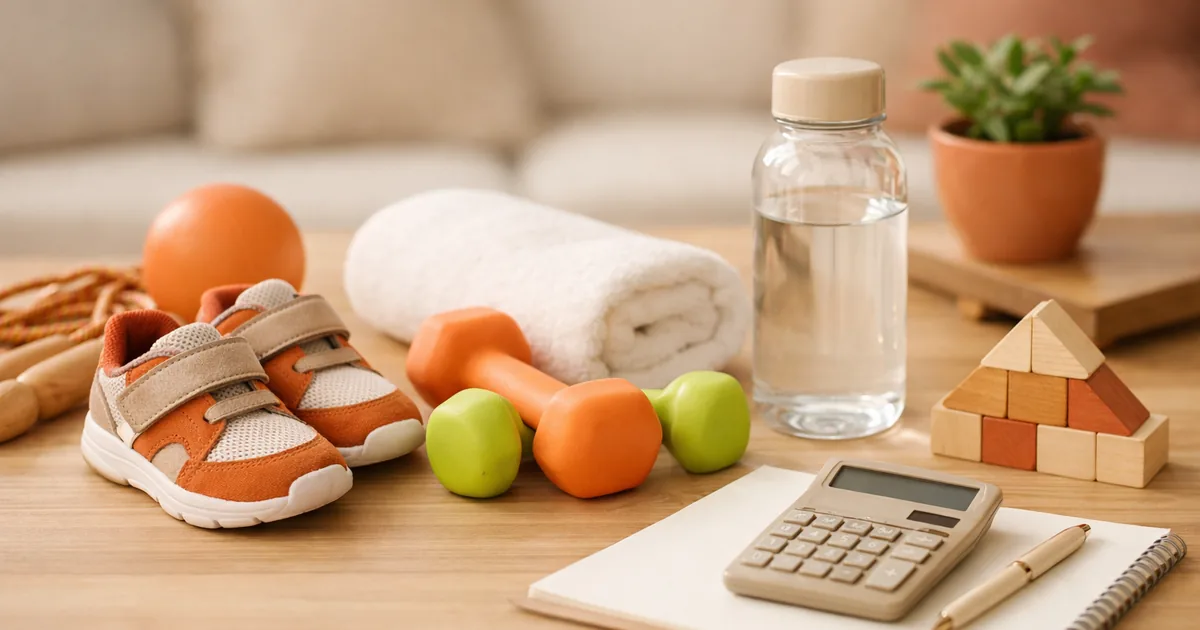
What actually counts as physical activity for a child? The US Centers for Disease Control and Prevention (CDC) says children and adolescents aged 6 to 17 need at least 60 minutes every day, and that the 60 minutes should mix three kinds of activity: aerobic activity that makes the heart beat faster, at moderate or vigorous intensity every day, plus muscle-strengthening and bone-strengthening activity on at least 3 days a week each. Its table of examples shows that many activities fall into more than one type — jump rope, for instance, appears under both vigorous aerobic and bone-strengthening. This page sets out the CDC “What Counts for Children and Teens” page as written, with a checker that counts the days still short in a week.
1. Ages 6 to 17: at least 60 minutes every day — aerobic activity every day, moderate or vigorous.
2. Muscle- and bone-strengthening: at least 3 days a week each — as part of the 60 minutes, not on top of it.
3. One activity, several types — jump rope and running are vigorous aerobic and bone-strengthening. 5 days of 60 minutes, 2 muscle days and 3 bone days leave 2 days short and 1 more muscle day (our sum).
Checker
More muscle days needed: - · More bone days needed: - · Types the picked activity covers (aerobic, muscle, bone): -
Results update as you type. “Days short” is 7 minus the days with 60 minutes, and muscle and bone are 3 minus the days done (not below 0) — our sums. The activity types come from the CDC table below (school-aged column); basketball and gymnastics are the examples on the CDC page “Making Physical Activity a Part of a Child’s Life”. Bicycling and swimming appear under both moderate and vigorous in the CDC lists, so they count as one aerobic type.
For example, 5 days of 60 minutes, 2 muscle-strengthening days and 3 bone-strengthening days leave 2 days short and 1 more muscle day, with bone already met (our sum). Picking jump rope shows aerobic (vigorous) and bone-strengthening — 2 types. Among the CDC examples, gymnastics lessons cover 3 types at once: vigorous aerobic, muscle- and bone-strengthening.
How much, in the CDC’s words
| Age or type | CDC page | Worth noting (our gloss) |
|---|---|---|
| Ages 6 to 17 | At least 60 minutes every day, with a mix of aerobic, muscle- and bone-strengthening across the week | The three types sit inside the 60 minutes |
| Aerobic | Moderate or vigorous intensity every day | This page gives no number of vigorous days |
| Muscle-strengthening | At least 3 days each week | e.g. climbing, push-ups |
| Bone-strengthening | At least 3 days each week | e.g. running, jumping |
| Intensity | In general, at moderate intensity children can talk but not sing; at vigorous intensity they can say only a few words before pausing for breath | The same talk test used for adults |
| Ages 3 to 5 | Physically active throughout the day for growth and development; adult caregivers encourage active play with a variety of activity types | The CDC gives no minutes for ages 3 to 5 |
The CDC says children should be encouraged to do any activity that is safe, suits their age and ability, and that they enjoy. It also points out that some activities, such as bicycling or basketball, can be done at either moderate or vigorous intensity.
What goes where — the CDC examples
| Type | School-aged children | Adolescents |
|---|---|---|
| Moderate aerobic | Brisk walking · bicycling on mostly flat ground · active recreation such as hiking, riding a non-motorized scooter, swimming · catch-and-throw games such as baseball and softball | Brisk walking · bicycling on mostly flat ground · kayaking, hiking, swimming · house and yard work such as sweeping or pushing a lawn mower · catch-and-throw games |
| Vigorous aerobic | Running · bicycling (may include hills) · running and chasing games such as tag or flag football · jump rope · cross-country skiing · martial arts · sports such as soccer, basketball, swimming and tennis · vigorous dancing | Same as school-aged children |
| Muscle-strengthening | Tug of war · body-weight or resistance-band exercises · rope or tree climbing · climbing on playground equipment · some forms of yoga | Tug of war · body-weight, resistance-band, weight-machine or hand-held weight exercises · some forms of yoga |
| Bone-strengthening | Hopping, skipping, jumping · jump rope · running · sports with jumping or rapid changes in direction | Jump rope · running · sports with jumping or rapid changes in direction |
Reading the rows together, jump rope and running sit in both vigorous aerobic and bone-strengthening, and basketball spans vigorous aerobic (as a sport) and bone-strengthening (a sport with jumping) — our reading. The school-aged muscle row has three kinds of climbing, so hanging and climbing at the playground is muscle work in itself; weight machines and hand-held weights only appear in the adolescent column.
Covering two or three types in one go
Another CDC page, “Making Physical Activity a Part of a Child’s Life”, gives examples of one activity covering several types: a daughter who practises basketball with her team every day gets vigorous aerobic and bone-strengthening activity, and a son who takes gymnastics lessons gets vigorous aerobic activity plus muscle- and bone-strengthening. So there is no need to add “60 minutes + muscle + bone” separately — what matters is whether muscle and bone work each turn up on 3 days in the week (our gloss). That is why the checker asks for days, not minutes, for muscle and bone.
The amounts themselves, the 180 minutes a day for under-5s and the screen-time and sleep advice from the World Health Organization are in how much activity children need (WHO). The adult talk test and perceived exertion scale are in how to measure exercise intensity, to read side by side. The 7 things parents can do and the 8 benefits for children are in helping children be active (CDC).
Checklist
- ☐ Ages 6 to 17 — 60 minutes today (aerobic every day)
- ☐ Muscle-strengthening (climbing, tug of war, body-weight moves) on 3 days this week
- ☐ Bone-strengthening (jumping, jump rope, running) on 3 days this week
- ☐ Can talk but not sing = moderate; only a few words = vigorous
- ☐ Ages 3 to 5: active play of many kinds throughout the day, not a number
- ☐ Enjoyable, right for their age and ability, and safe
Questions that remain
Does school PE count toward the 60 minutes?
Another CDC page says school-based physical activity programmes can help children reach their daily activity levels. How many minutes PE lasts, and how much of it is moving, differs between schools, so the checker only asks for days with 60 minutes.
How many days of vigorous activity?
The CDC page used here gives no number of days for vigorous aerobic activity. It only says aerobic activity should be moderate or vigorous every day.
What about a child with a disability?
The CDC says physical activity matters for all children, and advises talking with a doctor before starting and asking a professional experienced in physical activity and disability about suitable amounts and types.
Sources
- CDC — What Counts for Children and Teens — source (page shows: reviewed 8 January 2024; checked 17 November 2026). 60 minutes every day for ages 6 to 17, aerobic every day, muscle and bone at least 3 days, the talk test, ages 3 to 5 throughout the day, the examples table.
- CDC — Making Physical Activity a Part of a Child’s Life — source (page shows: reviewed 7 August 2024). The basketball and gymnastics examples, school programmes, children with a disability.
- Not read. The full Physical Activity Guidelines for Americans, 2nd edition; the CDC Move Your Way activity tool; the research behind each activity’s intensity; Korean physical activity guidelines for children and adolescents.
- What we added. The “worth noting” column, the checker’s days-short and days-to-go sums, and the reading across the examples table.
Where to check further
- Your child’s doctor — when a child with a health condition or disability starts being more active.
- School PE and after-school programmes — whether they can cover muscle and bone days during the week.
Written on 17 November 2026. The content is from the CDC; the glosses and sums are ours.