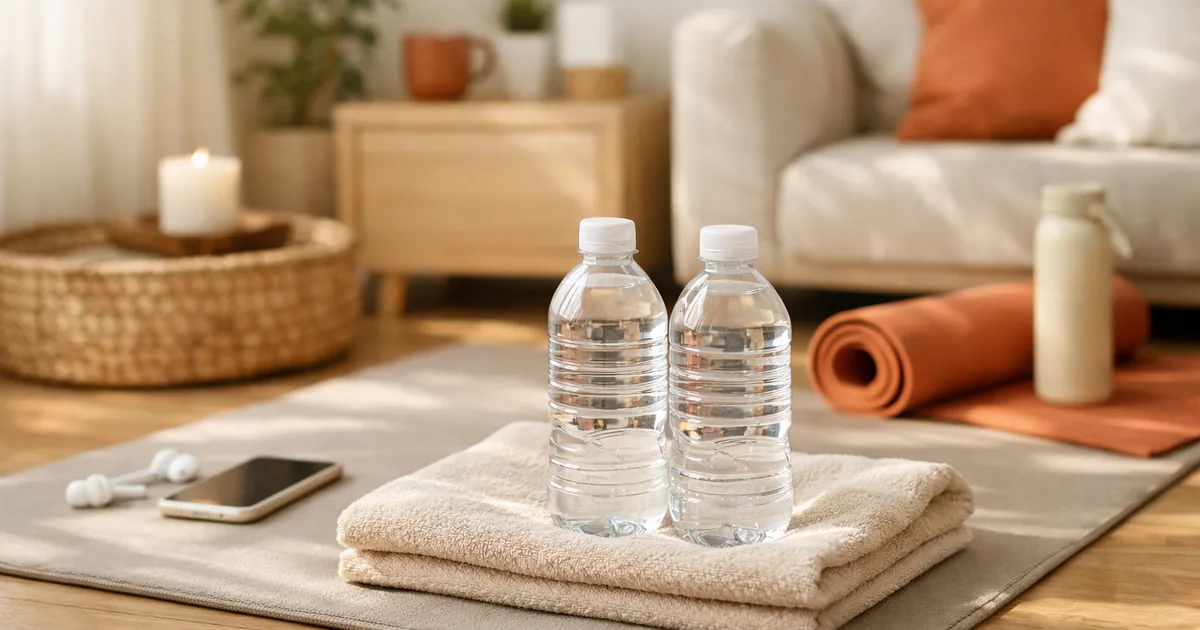
Bodyweight training gets you reasonably far on legs and core, then stalls at the upper body. Push-ups alone don't reach the back or the side of the shoulder, and a dumbbell set is awkward on both price and storage. This article keeps the constraint — no equipment — and fills the upper body anyway. What's in your fridge is enough: a 500ml water bottle is about 0.5kg and a 1.5L is about 1.5kg, which lands exactly in the beginner's upper-body range.
1. What changes. It fills the parts bodyweight work misses — back, side deltoid and triceps — toward the “strength work on 2+ days a week, all major muscle groups” that WHO and the CDC both ask for.
2. Where the risk is. Light weight means swinging it loads the joint instead of the muscle. If pressing overhead catches or hurts at a particular angle, drop that movement — and if you are being treated for something, agree the selection with your clinician first.
3. How to start. One 1.5L bottle (about 1.5kg) is enough. Set the weight with the water level, and stay in control on the way down — that is the whole technique.
Before you start: slow and precise beats heavy. Don't swing the weight up, and stay in control on the way down. The nice part about bottles is you can dial the weight with the water level.
Check your constraints — what's actually in the way
“I can't train my upper body” has different causes. Whether it's the lack of equipment, the lack of storage, or a shoulder that hurts changes which moves you should pick.
- You own no equipment at all — no dumbbells, no bands.
- Even if you bought some, there's nowhere to keep it, or you move often.
- You can't do a single push-up, or only from the knees.
- Raising an arm overhead catches or hurts at a particular angle.
- Your wrists are weak, so anything with hands on the floor is uncomfortable.
| Your situation | The real blocker | Where to look in this article |
|---|---|---|
| No equipment at all | Nothing to create resistance | The workaround table + all five moves |
| Nowhere to store it | The bulk of equipment | Steps 1 and 2 of the expansion order |
| Can't do a push-up | Absolute chest and triceps strength | ① shoulder press and ⑤ triceps extension |
| Shoulder hurts at an angle | The overhead range | The “If conditions are worse” notes under ① and ③ |
| Weak wrists | Loading the hands on the floor | The whole article — nothing here uses the floor |
None of the five moves puts your hands on the floor. If planks and push-ups were where you got stuck because of your wrists, this is the alternative route. If your positioning basics are still shaky, read home workout basics first.
The principle behind the workaround — what you need is resistance, not equipment
Muscle doesn't respond to “dumbbells”, it responds to resistance. Whether that resistance is made of iron or water is not a distinction the muscle makes. The real gap is that a bottle is lighter than a dumbbell — and that gap closes by slowing the tempo and adding pauses. The same 1.5kg lifted in one second and lowered over three seconds are two different loads. The table below is the blueprint.
| What's blocked | Why it's blocked | The substitute principle | The move here |
|---|---|---|---|
| Dumbbell shoulder press | No equipment, no weight increments | Water level gives you increments of 0.2kg — finer than most dumbbell sets | ① Shoulder press |
| Lat pulldown, barbell row | Bulky, needs a fixed setup | Hinge forward and change the direction of gravity to reach the same back muscles | ② Bent-over row |
| Lateral raise machine | No light increments, too heavy for beginners | Side delts want light weight anyway, so a bottle is the right load | ③ Lateral raise |
| Barbell curl | Needs a bar and plates | Pin the elbow and 1.5kg is plenty for the biceps | ④ Biceps curl |
| Dips, push-ups | Require pressing your whole body weight | Press one bottle instead of your body to reach the same triceps | ⑤ Triceps extension |
The World Health Organization recommends adults do muscle-strengthening activities involving major muscle groups on 2 or more days a week. The US Centers for Disease Control and Prevention sets the same bar and spells out the groups: legs, hips, back, abdomen, chest, shoulders and arms. The last four on that list are exactly what bodyweight home training tends to skip, and these five moves cover them. Pair it with low-noise home cardio and both halves of the guidance are met.
The five moves at a glance — fit by condition
You don't need all five every session. Choose by bottle size and shoulder condition.
| Move | Main target | Bottle size | Can be seated | Shoulder load | Reps |
|---|---|---|---|---|---|
| ① Shoulder press | Front and top of shoulder | 2 × 1.5L | Yes (recommended) | High | 10–12 reps × 3 sets |
| ② Bent-over row | Mid-back and lats | 2 × 1.5L | Yes | Low | 12 reps × 3 sets |
| ③ Lateral raise | Side delts | 2 × 500ml | Yes | Moderate | 12–15 reps × 3 sets |
| ④ Biceps curl | Front of the arm | 2 × 1.5L | Yes | Very low | 12 reps × 3 sets |
| ⑤ Triceps extension | Back of the arm | 1 × 1.5L | Yes (recommended) | Moderate | 10–12 reps × 3 sets |
Only ③ uses 500ml. The side delt is a small muscle, so going to 1.5L usually means shrugging and letting the upper traps take over — which leaves your neck stiff. If your neck and shoulders are already tight, put shoulder mobility stretches at the front of the session.

① Shoulder press (shoulders) — the water level is your weight rack
Holding a bottle in each hand, press from ear height up overhead and lower slowly. This goes first because it demands the most force of the five, and form holds only while you're fresh. Brace the abs so the lower back doesn't arch; sitting down reduces back strain further. This is where bottles shine most — fill to two-thirds and you have 1kg, an in-between step no dumbbell set gives you.

If conditions are worse: if the shoulder catches at a particular overhead angle, press only to forehead height instead of locking out. You avoid the painful range and still work the muscle. A chair with a back makes it steadier. If you have room: pause a second at the top and take three seconds down — the same 1.5kg feels considerably heavier.
② Bent-over row (back) — change gravity instead of buying a machine
Knees softly bent, hinge the torso to about 45° with a flat back, then pull the bottles toward your waist. Back work usually needs equipment because something has to sit in front of you to pull against; hinging forward makes gravity do that job. Think squeezing the shoulder blades together rather than pulling with the arms. Of the five, this acts most directly on a rounded upper back, so it pairs naturally with posture and back work.

If conditions are worse: if your lower back complains, brace one hand on a chair and row one side at a time. The arm carries your torso weight, cutting back load by more than half, and it's actually easier to feel the back muscle. If you have room: hold the squeeze at the top for two seconds and the mid-back engages unmistakably.
③ Lateral raise (side delts) — light is the correct answer here
With arms straight, raise them out to the sides up to shoulder height and lower slowly. This is the one place a bottle beats a dumbbell. The side delt is small, so anything heavy recruits something else instead, and 500ml is about right. Don't shrug — lift with the arms only, with the little finger turned very slightly upward to sharpen the target.

If conditions are worse: if shoulder height hurts, stop at chest height. Empty bottles are enough for the first two weeks. If you have room: fill the 500ml completely and take three seconds down — the end of the set burns properly.
④ Biceps curl (front arms) — pin the elbow and light weight is enough
Pin the elbows at your sides and curl the bottles toward your shoulders, then lower slowly. The biceps crosses one working joint here, so it gets plenty of stimulus from a small load. There's one condition attached: the moment the elbow drifts forward, the shoulder takes a share and the effect disappears. Swinging the body up is the same loss for the same reason. Taking 2–3 seconds on the way down is half of this exercise.

If conditions are worse: if the elbows keep creeping forward, stand with your back against a wall — the wall holds the position for you. If you have room: raise both together, then lower and raise one side at a time so the other holds an isometric load.
⑤ Overhead triceps extension (back of arms) — press a bottle instead of your body
Hold one bottle with both hands and lower it behind your head, then press up. The triceps is normally trained with push-ups or dips, and both require pressing your entire body weight, which locks beginners out completely. This move shrinks the thing you're pressing down to a single bottle and reaches the same muscle. The only condition is keeping the elbows beside your ears rather than flaring out.

If conditions are worse: if taking the arms behind your head bothers the shoulder, hinge forward instead and extend only at the elbow, arm alongside the body. Same triceps, far friendlier shoulder angle. If you have room: move to a 2L bottle and drop to 8–10 reps to shift into the strength range.
Combinations by situation — pick what fits the day
One round of ①–⑤ takes about 15 minutes. Do it 2–3 times a week, every other day — the upper body needs about 48 hours to recover, and training it daily actually slows progress.
| Situation | Combination | Session | Why |
|---|---|---|---|
| Default (2–3× a week) | ① → ② → ③ → ④ → ⑤ (all) | 15 min | Ordered from most to least force required |
| Shoulder is sore | ② → ④ | 8 min | Removes ①③⑤, the overhead work |
| Only one 1.5L bottle | ⑤ → ② one side → ④ one side | 12 min | Single-arm work lets one bottle serve everything |
| Rounded upper back is the goal | ② × 3 sets → ③ → ④ | 12 min | Concentrates volume on the pulling move |
| Only 8 minutes | ① → ② | 8 min | Keeps the two largest muscle groups |
If shoulder load worries you, the WHO's musculoskeletal figures are worth knowing. Approximately 1.71 billion people globally live with musculoskeletal conditions, and 222 million of those are neck pain. Letting the neck do the shoulder's work on overhead moves, repeated for months, is how people join that number. If your neck is already stiff, run forward-head-posture stretches alongside this.

When the constraint lifts, expand in this order
Bottles usually stay adequate for two to four months. Once the last 2–3 reps stop being hard, move up in this order.
- Water level first. Half to full. That alone gives you three steps — roughly 0.75kg, 1.1kg and 1.5kg.
- Then tempo. Before adding weight, stretch the lowering phase from two seconds to four. It's the only progression that costs neither money nor storage space.
- Then bulk. 2L bottles, or a bag loaded with books held by the handles. If “nowhere to store it” is still true for you, this is the ceiling.
- Equipment last. Bands take almost no space, so they suit the storage-limited first; adjustable dumbbells come after. The standard never changes: a weight where the last 2–3 reps are hard.

When this approach isn't enough
Some things don't get solved by swapping the tool.
- The bottle slips and your form collapses — peeling the label and wrapping a towel around it fixes most of this. If you still lose grip, move to bands.
- Shoulder pain in ①③⑤ that is getting worse or has not improved after 2 weeks — the NHS says see a GP. Sudden or very bad pain, not being able to move the arm, or bad swelling is urgent (urgent GP or NHS 111).
- Pain inside the joint during the set, not soreness the next day — our rule is to stop for the day.
- Pins and needles that do not go away, or no feeling in the arm or shoulder — the NHS shoulder pain page treats this as urgent (urgent GP or NHS 111).
- Your goal is slimming the arms specifically — this article won't do that. Spot reduction isn't possible; strength work plus cardio and diet lower overall body fat, and that's what changes your arms.
- You are under treatment for a shoulder or elbow condition — agree movement selection with your clinician first.
The NHS's six habits for moving more, such as getting up every 30 minutes, are in how to be more active (NHS).
Questions that remain
Do water bottles actually work?
Muscle doesn't respond to “dumbbells”, it responds to resistance, and whether that resistance is made of iron or water is not a distinction the muscle makes. A litre of water is a kilogram, so the recommended bottle size is the weight — a 1.5L bottle is about 1.5kg, which lands exactly in the beginner's upper-body range. The gap in load closes by slowing the tempo and adding pauses: the same 1.5kg lifted in one second and lowered over three are two different loads.
Why is ③ the only one at 500ml?
It is a third of the rest, because the side delt is a small muscle. Go to 1.5L and you usually end up shrugging, letting the upper traps lift it instead, which leaves the neck stiff. A lateral raise wants light weight anyway, which makes it the one place a bottle beats a dumbbell outright. Empty bottles are enough for the first two weeks.
How do I choose on a sore-shoulder day?
You don't have to read each load grade. The top three for shoulder load are exactly the three lifted overhead (①③⑤), so all you need to ask is whether it goes overhead. That is where the sore-day pairing of ② and ④ comes from. But a catching sensation at one particular angle that hasn't changed in three weeks is not a reason to lighten the bottle — it's a reason to see someone.
When do I add weight?
The standard never changes: a weight where the last 2–3 reps are hard. But in the order of progression, tempo comes before weight. ① Water level (half to full is already three steps — roughly 0.75, 1.1 and 1.5kg). ② Tempo (lowering from two seconds to four — the only progression that costs neither money nor storage). ③ Bulk (a 2L bottle, or a bag of books). ④ Equipment. If “nowhere to store it” is still true, you stop above step 3. Bottles usually stay adequate for two to four months.
My wrists are weak. Can I still train the upper body?
Yes. None of the five moves puts your hands on the floor — if planks and push-ups were where your wrists stopped you, this is the alternative route. One thing it will not do, though: slimming the upper arm specifically. Spot reduction isn't possible; the arm tidies up only when overall body fat drops, which takes strength work plus cardio and diet together.
Where to check further
- How to hit the weekly target. This article is one slice — the upper body. What the agencies actually ask for, per the CDC's adult activity guidelines, is 2+ days a week across all major muscle groups (legs, hips, back, abdomen, chest, shoulders, arms). Legs and core are covered in the lower-body workout.
- When the weight gets easy. Once 15 reps with a 1.5L bottle feels light, changing the movement beats adding bottles — the push-up progression is the next step that uses bodyweight as resistance.
- If something hurts. As WHO's musculoskeletal conditions fact sheet notes, neck and shoulder pain is common. If the shoulder catches, start with shoulder mobility work. Lifting through pain is not something this article recommends.
Where the moves and counts come from
The condition check, the combinations for each condition, and the order of the moves with their repetitions, sets and hold times are our own example. The sources below give activity amounts, condition information and when to see a doctor; they do not set counts for these moves. Where an agency gives the moves and counts itself, we carry them in its own words in stretching after exercise and strength and flexibility (NHS).
Sources used
- NHS — Shoulder pain · reviewed 22 May 2023, checked 15 October 2026 · source for the shoulder pain GP and urgent thresholds
- World Health Organization — Physical activity: muscle-strengthening involving major muscle groups on 2 or more days a week
- US Centers for Disease Control and Prevention — Adult activity guidelines: 2+ days of strength work and the major muscle groups (legs, hips, back, abdomen, chest, shoulders, arms)
- WHO musculoskeletal conditions fact sheet: approximately 1.71 billion people globally, of which 222 million neck pain
This article is general health information about meeting upper-body strength guidance without equipment, and does not replace medical diagnosis or treatment. If you are being treated for a rotator cuff injury or elbow tendinopathy, agree movement selection and loading with your clinician first, and stop if pain inside the joint or tingling in the arm appears during a set. The recommendations above apply to adults without a relevant diagnosis. Written as of July 2026.