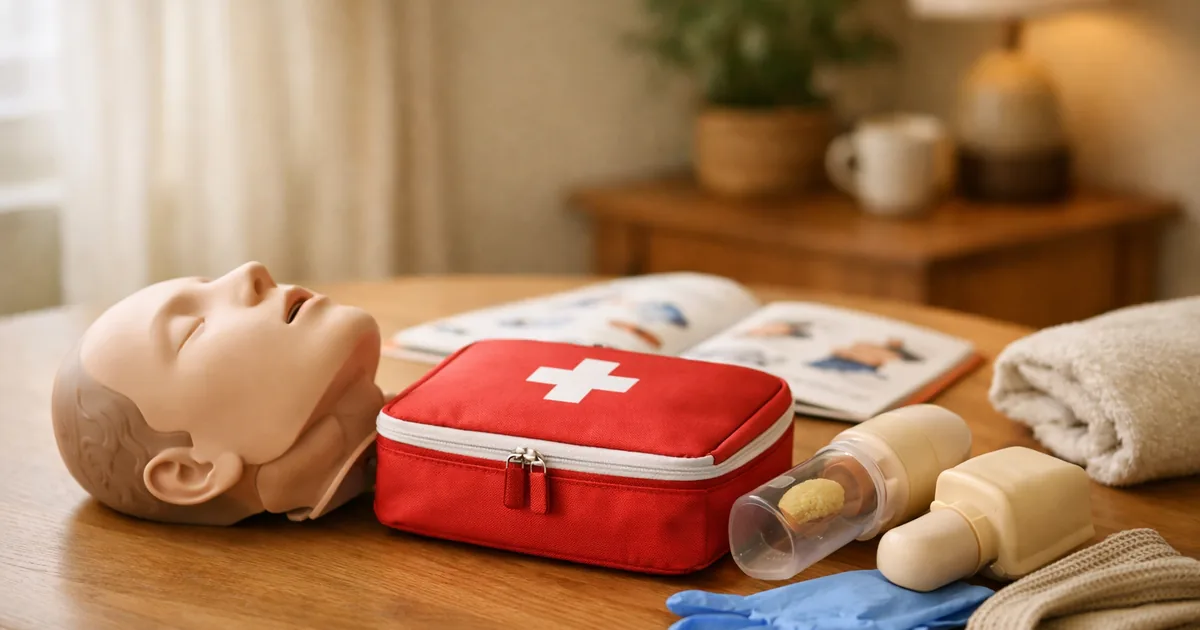
Cardiac arrest gives no warning — and most of the time it happens at home. That means the person you may one day need to resuscitate is far more likely to be a family member than a stranger on the street. The technique is not complicated. This guide walks through CPR and choking response step by step, in an order you can actually remember.
Why the first 4 minutes decide everything
When the heart stops, oxygen to the brain stops with it. Brain damage begins within about 4–5 minutes, and survival odds drop steeply with every minute after that. Ambulances almost never arrive that fast. The bystander — you — pressing on the chest is what doubles or triples survival.
CPR in 6 steps
| Step | Action | Key point |
|---|---|---|
| ① Check response | Tap the shoulders and shout "Are you okay?" | Tap, don't shake |
| ② Call for help | Point at someone: "You — call emergency services and bring an AED" | Alone? Put your phone on speaker with the dispatcher |
| ③ Check breathing | Look for chest movement for up to 10 seconds | Gasping, irregular breaths count as NOT breathing |
| ④ Chest compressions | Center of the chest (lower half of the breastbone), 100–120 per minute, about 5 cm (2 inches) deep | Arms straight, use your body weight, let the chest fully recoil |
| ⑤ Rescue breaths (if trained) | 30 compressions : 2 breaths, repeat | Never trained? Hands-only CPR is fine — just don't stop pressing |
| ⑥ When the AED arrives | Turn it on and follow the voice prompts | Place pads as pictured; hands off during analysis |
Key point. For untrained rescuers, hands-only CPR is the recommended standard. Hesitating because rescue breaths feel daunting costs lives; uninterrupted compressions save them. The right tempo matches the beat of "Stayin' Alive" or "Baby Shark."
How it changes by age
The principle is identical, but hand position and depth scale with body size. In children, cardiac arrest is more often breathing-related, which makes rescue breaths more valuable if you know them.
| Age | Position & hands | Depth | Rate |
|---|---|---|---|
| Adults (post-puberty) | Center of chest, two hands interlocked | ~5 cm / 2 in (not over 6 cm) | 100–120/min |
| Children (1 to puberty) | Center of chest, one or two hands | 1/3 of chest depth (~5 cm) | 100–120/min |
| Infants (under 1) | Just below the nipple line, two fingers | 1/3 of chest depth (~4 cm) | 100–120/min |
AED: the machine talks you through it
Defibrillators hang in subway stations, gyms, offices, and shopping malls. Turn one on and a voice guides every step. The device analyzes the heart rhythm itself and will only deliver a shock if one is needed — you cannot hurt someone by attaching it. Keep compressions going while the pads go on.
Choking: the guidance was updated
If someone can't speak, can't cough, and clutches their throat, the airway is fully blocked. Under the 2025 American Heart Association guidelines, the recommended response is no longer abdominal thrusts alone — it's alternating 5 back blows with 5 abdominal thrusts.
| Who | Method | Caution |
|---|---|---|
| Adults & children (1+) | ① From behind, give 5 firm back blows between the shoulder blades with the heel of your hand → ② wrap your arms around, fist above the navel, and pull up and in 5 times (abdominal thrusts) → repeat ①② until the object comes out | If they can still cough, let them keep coughing — don't interfere |
| Infants (under 1) | Face-down along your forearm, head low: 5 back blows → flip over: 5 chest thrusts with two fingers just below the nipple line → repeat | Never do abdominal thrusts on an infant |
| Pregnant or larger-bodied | Thrust at the chest instead of the abdomen | - |
| If they pass out | Lower them to the floor and start CPR immediately; call emergency services | Only remove an object you can actually see — no blind finger sweeps |
A real-world example: holiday dinner, and grandpa stops talking
Mid-meal, he suddenly goes silent and grips his throat. ① Ask: "Are you choking? Can you speak?" No voice, no cough — that's a full obstruction. ② Send someone to call emergency services while you stand behind him alternating 5 back blows → 5 abdominal thrusts. ③ When the food pops out, let him rest — but if abdominal thrusts were used, he should be checked at a hospital for internal injury. ④ If he goes limp, lay him down and start chest compressions until help arrives. The whole scenario plays out in under three minutes. Rehearse it mentally once, so your body remembers.
Prepare before you ever need it
- ☐ Learn where the AEDs are in your building, office, and gym
- ☐ Take a CPR class — Red Cross chapters and fire departments run cheap or free sessions
- ☐ Elderly family at the table: cut rice cakes and meat small; swallow first, talk second
- ☐ Small children: no whole nuts, hard candy, or whole grapes (top choking causes under age 4)
- ☐ Review home emergency responses and stock a first-aid kit
- ☐ Traveling soon? Save the destination's emergency number — see our travel emergency guide
FAQ
Q. I'm scared of breaking ribs if I push that hard.
Ribs sometimes do crack during CPR — and they heal. A stopped heart is far more fatal than a broken rib. Five centimeters is deeper than most people expect; lean in with your full body weight.
Q. Could I be sued for doing it wrong?
Most countries — including Korea, the US, and much of Europe — have Good Samaritan laws protecting people who give emergency aid in good faith. Standing by and watching is the worst legal and moral position of all.
Q. They're unconscious but seem to be breathing. Compress anyway?
If breathing is clearly normal, don't compress — roll them into the recovery position (on their side) and monitor until help arrives. But irregular gasping is a sign of cardiac arrest, not breathing: start compressions. Dispatchers can talk you through the call.
Q. What if I'm alone and choking?
Call emergency services first — even if you can't speak, the call can be traced. Then press your upper abdomen forcefully against a chair back or table edge to perform abdominal thrusts on yourself.
CPR isn't an expert skill — it's a basic skill for anyone with a family. Tap, call, then push hard, fast, and without stopping. That alone can double or triple someone's chance of coming home.
This article reflects the 2025 international guideline update and is general information — it doesn't replace hands-on training. Take one practical class; your hands will remember what your eyes read here. For deciding when symptoms need an emergency room, see ER or clinic?