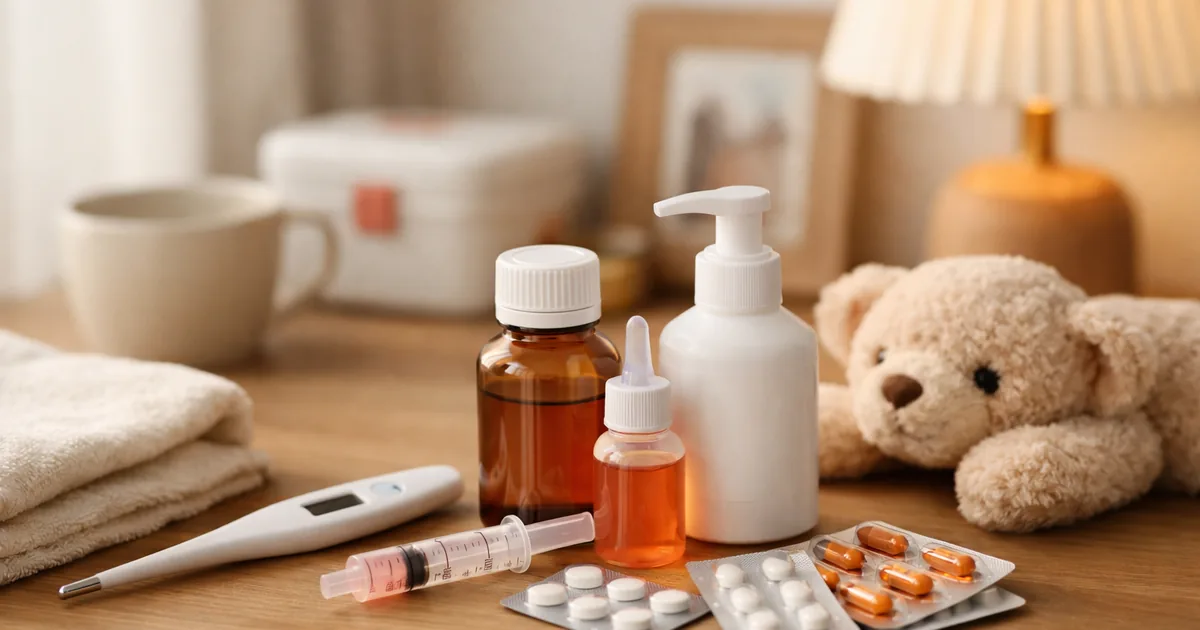
It's the middle of the night and your baby's forehead is burning. The thermometer reads 39°C. Your mind goes blank — medicine now, ER now, or is a seizure coming? Fever in babies and toddlers is usually a normal response to fighting infection, but the right action changes completely with the child's age and symptoms. Knowing the thresholds in advance keeps you calm at 3 a.m.
Three principles first
- Fever is a signal, not a disease. The goal isn't a lower number — it's keeping your child comfortable and not missing danger signs.
- The threshold is 38°C. Armpit or ear temperature of 38°C or higher counts as fever. Medicine is usually given above 38°C when the child is uncomfortable.
- Younger means stricter. In particular, under 3 months, a fever itself is an emergency (see below).
Fever thresholds by age
| Age | At this temperature | Do this |
|---|---|---|
| Under 3 months | 38°C+ | Do NOT give medicine — go to a doctor/ER immediately. Fever this young can signal serious infection |
| 3–6 months | 38°C+ | See a doctor soon. Only acetaminophen is usable (ibuprofen starts at 6 months) |
| 6 months+ | 38°C+ and uncomfortable | Use medicine to ease discomfort, observe, and watch for danger signs |
| Any age | 40°C+ | Emergency — call for help immediately |
Unsure whether to go now or wait for the clinic? See our ER vs. clinic guide. In Korea, after-hours pediatric (Moonlight) clinics are another option.
How to use fever medicine
There are just two drug classes for babies, and the dose is by weight, not age. Always follow the package and your doctor/pharmacist.
| Ingredient | Usable from | Interval | Note |
|---|---|---|---|
| Acetaminophen (e.g., Tylenol) | 4 months+ | Every 4–6 hrs | Gentle on an empty stomach |
| Ibuprofen | 6 months+ | Every 6–8 hrs | Use carefully with vomiting/dehydration; keep fluids up |
Don't casually alternate. Alternating the two can help a stubborn fever, but the American Academy of Pediatrics does not recommend routine alternating because of confusion and overdose risk. If truly needed, ask your pediatrician, write down each dose and time, and keep at least a 2-hour gap.
Never do these
| Don't | Why |
|---|---|
| Rub the body with alcohol | Absorbed through skin — risk of alcohol poisoning in infants |
| Ice packs or cold-water baths | Blood vessels constrict, core temperature rises, child shivers |
| Split adult medicine | Impossible to dose accurately — over/underdose risk |
| Force medicine on a fixed clock | The child's state matters, not the clock; if they sleep peacefully, don't wake them |
| Bundle in thick clothes/blankets | Traps heat. Dress light and wipe with a lukewarm cloth |
Febrile seizures: what to do
Between 6 months and 5 years, a rising fever can trigger a febrile seizure — eyes rolling, limbs shaking. It's more common than parents think and usually stops on its own within minutes. Panicked mishandling is the bigger danger.
| Step | Action |
|---|---|
| ① Note the time | When the seizure started (over 5 minutes → call for help) |
| ② Turn on their side | Lay them flat, face to the side so saliva/vomit doesn't enter the airway |
| ③ Clear the area | Move hard objects away; loosen clothing and diaper |
| ④ Just watch | Put nothing in the mouth (no spoon/finger — "biting the tongue" is a myth) |
| ⑤ Record | Film it if you can — a huge help for the doctor's diagnosis |
Over 5 minutes, a first-ever seizure, or not waking properly afterward → call emergency services now. The basics of airway/seizure response are in our CPR and choking guide.
A real example: 3 a.m., a 15-month-old at 39°C
Your toddler wakes at 39°C. ① Give weight-appropriate medicine (acetaminophen or ibuprofen) and dress them lightly. ② Wipe forehead, armpits, and neck with a lukewarm cloth and offer fluids. ③ If the fever eases a bit within 30–60 minutes and they fall back asleep, an ER trip is often unnecessary. ④ But if they're limp, seizing, breathing hard, have no wet diaper for half a day, or have a stiff neck and are very fussy, go to the ER regardless of the hour. ⑤ In the morning, a pediatrician finds the cause. Judge by the child's whole state, not the number.
Signs to go to the ER now
- ☐ Under 3 months with 38°C+
- ☐ 40°C+ at any age
- ☐ Seizure, or one lasting over 5 minutes
- ☐ Limp, barely responsive, or only wanting to sleep
- ☐ Fast/labored breathing or bluish lips
- ☐ Stiff neck, or a rash that doesn't fade when pressed
- ☐ No wet diaper for 6–8 hours = dehydration
- ☐ Fever lasting 3+ days or steadily worsening
Key point. Medicine often won't bring the fever all the way to "normal" — that's fine. The goal is to lower it about 1–1.5°C so the child is comfortable. Whether they drink, respond, and can play matters far more than the exact number.
FAQ
Q. Can high fever damage the brain?
Fever from common infections (usually under 41°C) does not itself damage the brain. Conditions like meningitis are the danger, not the number. Still, get the cause checked if danger signs appear.
Q. The fever came back 30 minutes after medicine.
Medicine takes 30–60 minutes to work, and it can rise again while the cause persists. Keep to the dosing interval and help with lukewarm cloths and fluids in between. If they're miserable before the next dose is due, ask your pediatrician about alternating.
Q. Fever after vaccination — is it okay?
A mild fever for 1–2 days after shots is a common, normal reaction. Use weight-appropriate acetaminophen and keep fluids up. But if under 3 months, or 39°C+ with lethargy or seizure, seek care regardless of the shot.
Q. Can I bathe them during a fever?
A brief lukewarm (30–33°C) wipe or wash is fine. No cold water or alcohol. Stop immediately if they shiver — shivering raises temperature.
Baby fever isn't about fighting a number — it's about watching the child. Remember 38°C, 3 months, 40°C, seizure over 5 minutes, and you can stay calm at any hour.
This is general information, not a diagnosis. Babies change fast — when in doubt, contact a pediatrician or emergency line. Our home first-aid kit guide lists a baby thermometer and fever medicine. If vomiting or diarrhea is also present, see baby vomiting, diarrhea, and dehydration.