Most emergencies don't happen in hospitals — they happen at home. A pot of boiling water tips over, a knife slips, a child falls off the bed, a nosebleed won't stop at midnight. What you do in the first few minutes shapes how fast the injury heals — and sometimes whether someone survives. Here's a room-by-room guide to the most common home emergencies, focused on what to do and, just as important, what not to do.
Rules that apply to every emergency
- Take one deep breath first — panicked decisions make things worse. Three seconds is enough.
- Check consciousness and breathing first — if someone is unresponsive or breathing abnormally, drop everything and call emergency services. If cardiac arrest is suspected, start CPR.
- When in doubt, call and ask — emergency dispatchers in most countries can advise you over the phone and tell you whether an ambulance is needed.
Burns: the most common — and most mishandled — injury
Instant noodle soup, water dispensers, curling irons. The correct response is simple: cool running water for 15–20 minutes.
| Situation | Do | Don't |
|---|---|---|
| Any burn | Hold under cool (not icy) running water for 15–20 minutes; if clothing is soaked with hot liquid, pour water over it first | Apply ice directly (worsens tissue damage), or toothpaste, butter, and other folk remedies |
| If blisters form | Leave them intact and see a doctor | Pop the blisters (infection risk) |
| Go to a hospital when | Blistering burns, burns on the face, hands, joints, or genitals, area larger than the person's palm, electrical or chemical burns | Assume ointment alone will fix it |
Cuts and bleeding: pressure does 90% of the work
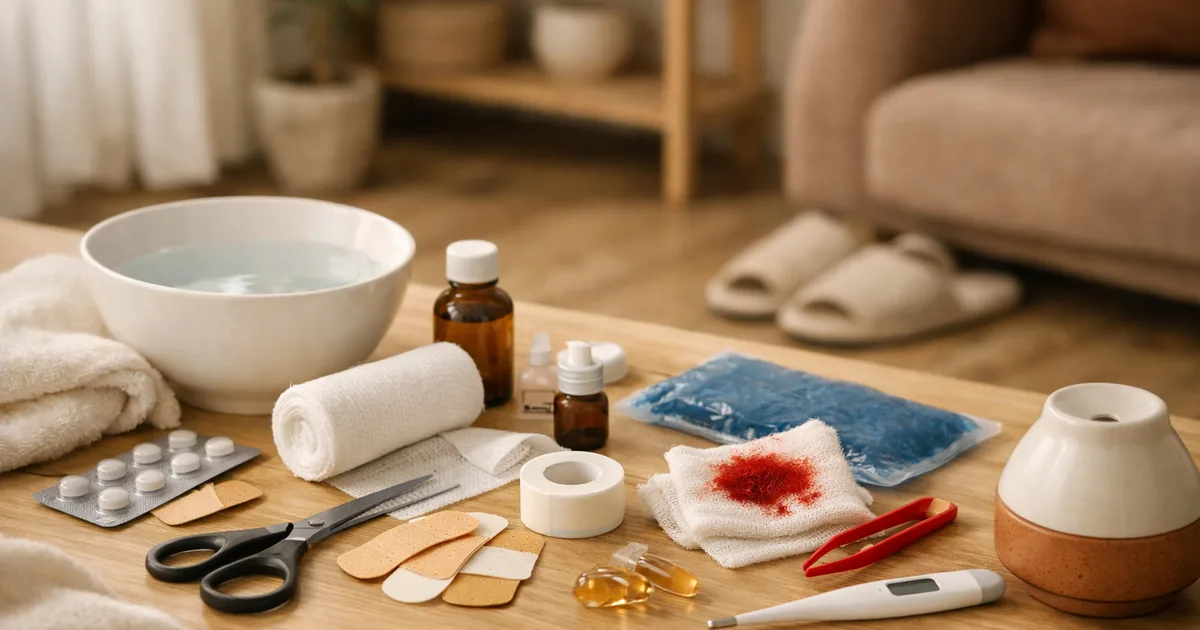
For a kitchen cut, the answer is direct pressure: press a clean gauze pad or towel firmly on the wound for at least 10 minutes. Don't keep lifting it to peek — that breaks the forming clot.
- Still soaking through after 10 minutes of pressure → keep pressing and head to a clinic
- Blood is spurting → call an ambulance and do not release pressure
- Deep or gaping wound → it may need stitches; go within hours, as delayed wounds often can't be sutured
- Puncture from a rusty object → check tetanus vaccination history
Sprains: 48 hours of RICE
For a rolled ankle or twisted wrist, the first 48 hours follow the classic RICE protocol.
| Step | How | Caution |
|---|---|---|
| Rest | Stop using the injured part | Don't keep "testing" it to see if it's fine |
| Ice | Towel-wrapped ice pack, 15–20 minutes, several times a day | No ice directly on skin; no heat in the first 48 hours |
| Compression | Wrap snugly with an elastic bandage | Tingling or color change means it's too tight |
| Elevation | Keep it above heart level | Foot up on cushions while resting |
If they can't bear weight at all or the joint looks deformed, it may be fractured — get an X-ray.
Nosebleeds: lean forward, not back
This is the one everyone gets backwards. Tilting the head back sends blood down the throat, causing gagging and vomiting. Instead, lean slightly forward and pinch the soft part of the nose firmly for 10 minutes straight. If it hasn't stopped after 20 minutes, see a doctor.
Quick-reference table for common situations
| Situation | First action | Never do | Call an ambulance if |
|---|---|---|---|
| Fall (elderly or child) | Keep them still; check where it hurts | Force the person up | Head was hit, they can't get up, or there's vomiting or confusion |
| Seizure | Clear hard objects away, roll them onto their side, time the seizure | Put fingers or spoons in the mouth; hold the body down | Lasts over 5 minutes or it's a first-ever seizure |
| Child swallowed an object | If they're coughing, let them keep coughing | Sweep the mouth blindly with fingers (pushes it deeper) | They can't breathe — start choking response; coins, magnets, and button batteries need a hospital even without symptoms |
| Swallowed medicine or detergent | Grab the container and call poison control / emergency services | Induce vomiting (burns the esophagus twice) | Button batteries and strong acids/alkalis: go to the ER immediately, always |
| Head bump | Watch for 24–48 hours: vomiting, drowsiness, odd behavior | Ignore it because they seem fine at first | Loss of consciousness, repeated vomiting, seizure, or unusual limpness |
| Suspected stroke | Check FAST: Face drooping, Arm weakness, Speech trouble — note the Time | Wait to "see if it passes with sleep" | Any one sign — call immediately (the treatment window is hours, not days) |
A real-world example: a child spills hot soup
Your 4-year-old pulls a bowl of hot soup onto their arm. ① Carry them straight to the bathroom and hold the arm under cool running water. If clothing is stuck, pour water over the fabric first, then cut it away with scissors. ② Keep cooling for a full 15–20 minutes while another adult gets ready to leave for the hospital. ③ If blisters rise, don't pop them — cover loosely with clean gauze. ④ Children's skin burns deeper than adults'; if the area is bigger than a large coin, have it seen. Knowing which ER is open before you need one helps — see ER or clinic: how to decide.
Home emergency-readiness checklist
- ☐ First-aid kit stocked: sterile gauze, bandages, antiseptic, fever reducer (see our first-aid kit guide)
- ☐ Everyone in the family knows the emergency call script: address → symptoms → age/sex → follow instructions
- ☐ Medication list and allergies posted on the fridge (where paramedics look)
- ☐ Button batteries, magnets, and detergents stored out of children's reach
- ☐ For elderly family: non-slip bath mats and night lights installed
- ☐ At least one adult in the house has learned CPR
Key point. First aid isn't treatment — it's keeping things from getting worse until professionals take over. Folk remedies (toothpaste on burns, alcohol on wounds) usually add damage. Cool it, press it, keep them still, and call for advice.
FAQ
Q. Povidone-iodine or hydrogen peroxide for cuts?
For minor wounds, washing with running water and soap comes first. If you disinfect, apply povidone-iodine around the wound. Hydrogen peroxide irritates healthy tissue and can slow healing, so it's no longer commonly recommended.
Q. Can I put burn ointment on right away?
Water before ointment, always. After 15–20 minutes of cooling, ointment is fine for first-degree burns (redness only). If there are blisters, skip the ointment and have it dressed at a clinic.
Q. My child fell, cried, then went right back to playing. Hospital or not?
Playing normally is reassuring, but observe for 24–48 hours. Repeated vomiting, unusual drowsiness, wobbly walking, or uncharacteristic fussiness means go now. When unsure, call your local medical advice line.
Q. An elderly parent fell but insists they're fine.
Falls in older adults can hide hip fractures behind "I'm fine." Pain when standing or a changed gait needs an X-ray. For prevention, gentle strength work helps — see our guides on walking for health and staying active.
Home first aid comes down to: cool it, press it, roll them sideways, and never force things out or force vomiting. And when you're not sure — call and ask.
This article provides general first-aid information and does not replace professional medical care. In a real emergency, follow the instructions of emergency dispatchers and medical staff first.