Among the 4,855 laundry-service complaints filed with Korea's Consumer Agency between 2022 and 2024, colour change (fading and discolouration) accounted for 855 cases (17.6%) and staining (dye transfer and soiling) for 813 (16.8%). Together that is a third of everything — colour problems. The heaviest month is May, with 569 cases (11.7%), up 41.9% on April, when winter clothes go in for cleaning.
Stains get harder to remove with time. So this guide starts not with what to use but how fast, and in what order. It also corrects one widely held belief about bleach, using the Consumer Agency's own test results.
The first three minutes decide it
Three rules come before choosing any product. Break them and nothing you apply afterwards works well.
- Fast. The moment it lands is the easiest it will ever be. Stains set into the fibre as they dry, and oxidise into a different colour after that.
- Blot, never rub. Rubbing spreads the stain through the weave and damages the surface. Press a tissue or dry cloth against it and lift the stain out. The trick is to place an absorbent cloth underneath and work from above.
- Cold water first. Blood, milk and egg are protein stains that set hard in hot water. If you can't identify it, use cold.

Of the 978 disputes attributed to launderers, 14.1% (138 cases) were "inadequate stain removal." Professionals miss these too — which means your own first response before handing it over changes the outcome substantially.
Treatment by stain type
Stains fall into four families — oil, protein, pigment and ink — and each dissolves in something different. Learn the families and you can judge stains that aren't in the table.
| Stain | Family | Order | Watch out |
|---|---|---|---|
| Coffee, tea | Pigment | Cold rinse → dish soap pre-treat → soak in oxygen bleach if it persists | Hot water fixes the pigment |
| Kimchi liquid, tomato | Pigment (+ oil) | Cold rinse → dish soap → oxygen bleach | On whites, sunlight fades the residue |
| Oil, cosmetics, lipstick | Oil | Apply dish soap directly, leave, then wash | Water first makes it worse |
| Blood, sweat, milk | Protein | Cold water only → soak in percarbonate → wash | Never hot — it sets permanently |
| Ballpoint ink | Ink | Tissue underneath, dab with rubbing alcohol to transfer it down | Broad rubbing spreads it. Test coloured fabrics first |
| Yellowed underarms | Oxidised sebum | Soak 1–2 hours in 40–50°C water with percarbonate → wash | Chlorine bleach makes yellowing darker |
| Mud | Solid particles | Let it dry completely, brush off, then wash | Rubbing it wet drives particles into the weave |
Mud is the one row that runs backwards. Everything else is easier before it dries; soil is particulate, so drying and brushing off works far better. Worked wet, the grit embeds itself.
Whichever method you choose, the fibre has to survive it. Apply the detergents and temperatures above to wool, silk or technical fabrics and the garment will fail before the stain does. What each fibre is vulnerable to is tabulated in the fabric care guide — check there first for anything you value.
Bleach removes colour when you soak in it
This is the part that is commonly misunderstood. Korea's Consumer Agency published a comparative test of 11 laundry bleach products in January 2024:
| Test condition | Colour change on dyed fabric | Stain removal |
|---|---|---|
| Normal wash (with detergent, in the machine) | None — all products | Liquid types better on sebum and dust |
| Soaking (dissolved in water, left to stand) | Change in every product tested | Powder types better on oil and soil |
In short: soaking in bleach removes the stain and some of the colour with it. All 11 products (8 powder, 3 liquid) were oxygen-based, and it happened anyway. "Oxygen bleach is safe on colours" holds only for a normal wash cycle.
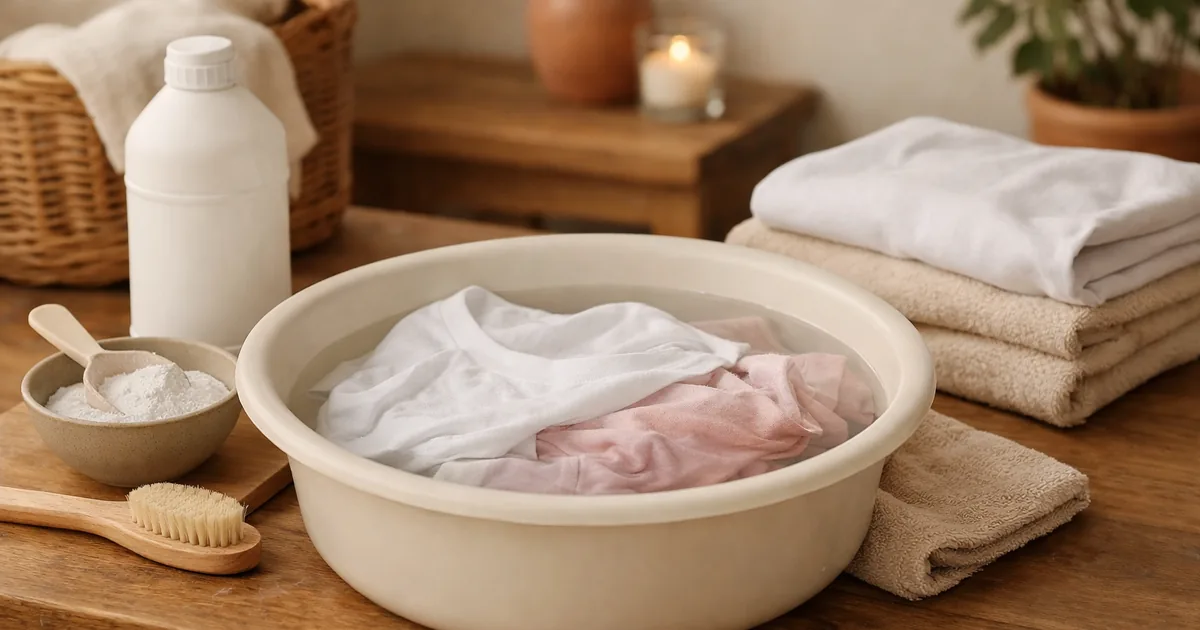
The working rule follows from that. Whites, or garments whose colour is already compromised, can be soaked. Coloured garments should go through a normal wash with detergent instead. If a stain is bad enough to need soaking, decide first whether you accept losing some colour.
One more thing: never combine oxygen bleach with chlorine bleach. The Consumer Agency warned that using the two together risks a violent reaction and chlorine gas. People mix them hoping for a stronger result — this is a safety issue, not a laundry one.
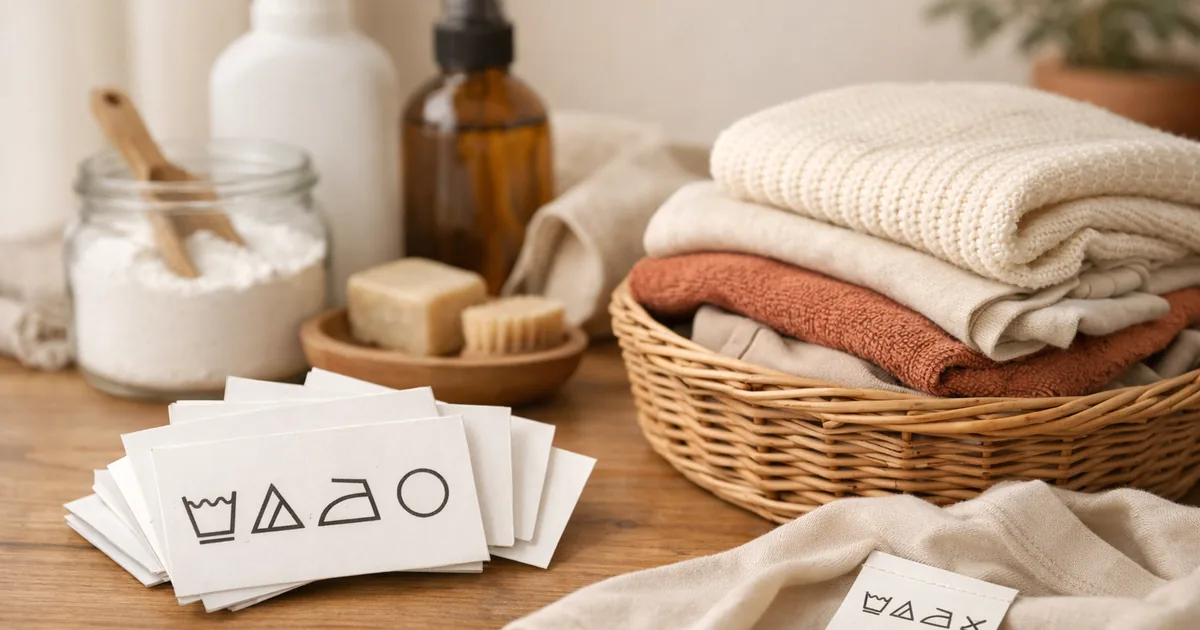
Before using any bleach, check the triangle symbol on the label. An X means no bleach. How to read the symbols is in the fabric care guide.
Dye transfer — twenty seconds of prevention
Colour migrating from one garment to another is the most avoidable stain there is.

| Step | Do | Why |
|---|---|---|
| 1 | Test new or dark garments with a damp white cloth on a hidden area | If colour transfers, wash separately for the first few cycles |
| 2 | Separate whites and lights from darks | The most reliable prevention there is |
| 3 | Wash cold | Hotter water releases more dye |
| 4 | Hang the load immediately | The longer it sits wet and bunched, the more transfers |
Step four catches more people than the others. You sort carefully, wash cold, then leave the load in the drum for a few hours and the transfer happens there. When a mixed load is unavoidable, a colour-catcher sheet absorbs loose dye from the water and limits the damage.
If transfer has already happened, before it dries is the only window. Once dry, the dye is fixed and the job gets much harder. Rewash immediately; if colour remains, soak in oxygen bleach — accepting, as above, that the garment's own colour may go with it.
Mistakes you cannot undo
- Hot water on a protein stain — blood, milk and egg set into the fibre and no detergent lifts them afterwards.
- Rubbing hard at a stain — the stain widens and the abraded patch takes on a different sheen.
- Soaking coloured items in bleach — the original colour goes too, and patchy loss shows more than the stain did.
- Mixing oxygen and chlorine bleach — risk of chlorine gas. Not a laundry problem.
- Drying a dye-transferred garment — drying fixes the dye.
- Putting a stained item in the dryer — heat sets the stain. Check before drying, not after.
That last one pays for itself. When the cycle ends, look at the item before you hang it; if the stain is still there, treat it again. Heat and time fix stains whether the source is a dryer or a sunny balcony. Sometimes the machine itself is the culprit — see washing machine care and bulky items. For humid-season odour and marks, managing humidity and mould in monsoon season is the companion piece.
Sources and where to verify
- Korea Consumer Agency — laundry service complaint statistics (4,855 cases 2022–2024, by defect type and month)
- Korea Consumer Agency textile committee findings — analysis published on the North Jeolla Province consumer board
- Consumer24 — analysis of laundry service disputes
- Consumer24 — always keep your laundry receipt
Written as of July 2026. The bleach findings come from the Consumer Agency's January 2024 comparative test of 11 laundry bleach products; the dispute statistics from its April 2025 and November 2024 releases. The agency's site blocks automated access, so the originals could not be read directly and were cross-checked against a public-sector republication and multiple press reports. Figures such as bacterial counts in drums or removal rates by wash temperature appear in many guides; no credible test data could be found for those, so they are not used here.