Of the 3,875 textile disputes reviewed by Korea's Consumer Agency textile committee between 2022 and September 2024, 978 were attributed to the launderer — and half of those (50.8%) came down to "unsuitable washing method." Even professionals get it wrong half the time. At home the odds are worse. Yet the correct method is already sewn into the garment: the care label.
This guide covers how to read the five symbol families used on Korean care labels, what each fibre is actually vulnerable to, and how to handle it accordingly. Laundry mistakes are mostly irreversible, which is what makes reading this once worthwhile.
Care labels have exactly five symbol families
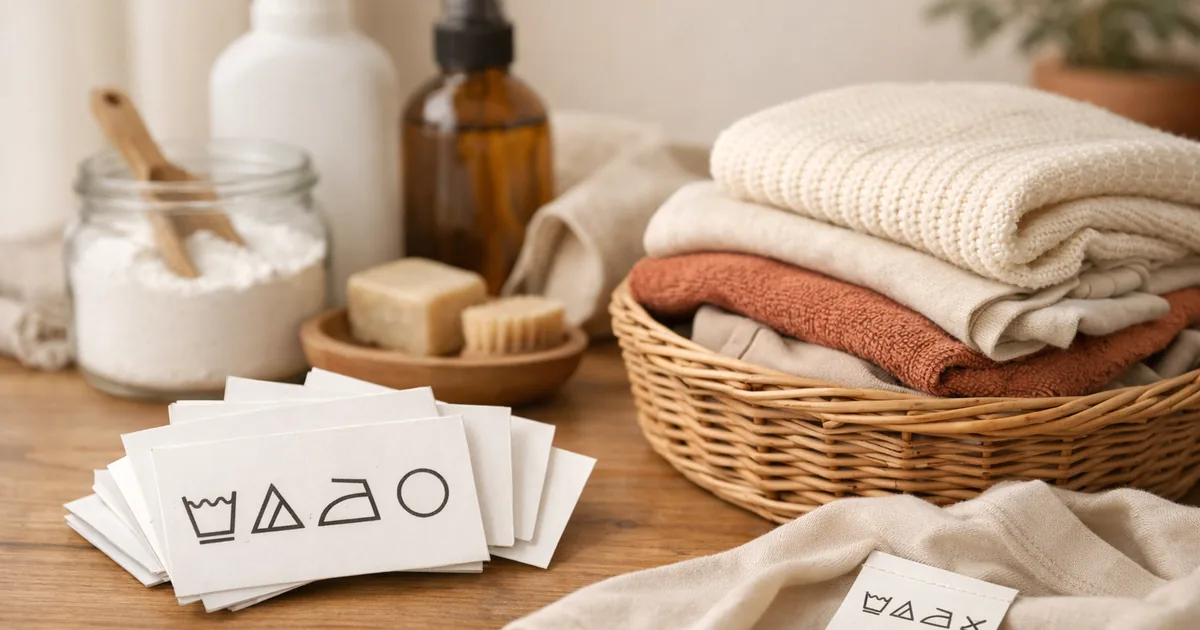
Korean care labels follow the national standard KS K 0021, "Textiles — care labelling code using symbols." It was established in 1972 and is still revised; the current edition was issued on 31 December 2024. There are five shapes. Learn the shapes and the numbers, dots and bars inside will tell you the rest.

| Shape | What it governs | What's inside | With an X |
|---|---|---|---|
| Tub (basin) | Machine washing and temperature | Number = maximum water temperature in °C. One bar below = gentle, two = very gentle. A hand in the tub = hand wash only | Do not wash → dry clean |
| Triangle | Bleaching | Empty = bleach permitted. Two diagonal lines = oxygen bleach only | Do not bleach |
| Square | Drying | Circle inside = tumble dry (dots indicate heat). Horizontal bar = dry flat, vertical bar = line dry | Do not use that drying method |
| Iron | Ironing temperature | One dot = low, two = medium, three = high | Do not iron |
| Circle | Dry cleaning | Letters inside (P, F and so on) indicate the solvent — that's for the cleaner, not you | Do not dry clean |
According to an article in Technical Standards, published by the Korean Agency for Technology and Standards, the washing symbol's maximum standard temperature is 95°C and the ironing maximum falls in the 180–210°C range (that piece dates from March 2008, so details may differ from the current edition). In practice the temperatures you'll actually see on labels are 30, 40 and 60°C.
Of the five, the X markings are the ones you must not ignore. The rest are recommendations; an X is a warning that this will destroy the garment. As the next section shows, most of those outcomes cannot be undone.
Each fibre fails in its own way
Once you can read the label, the next question is why it says what it says. Every fibre has a different breaking point — and knowing them lets you judge a garment whose label has worn away.
| Fibre | Most vulnerable to | What happens | Reversible? |
|---|---|---|---|
| Cotton, linen | Heat and repeated drying | Shrinkage, fading | Essentially no |
| Wool, cashmere | Temperature change plus friction | Fibres interlock and shrink (felting), surface pilling | Close to impossible |
| Silk | Alkaline detergent, direct sun | Loss of lustre, yellowing | Difficult |
| Polyester, nylon | High-temperature ironing | Surface melts, leaves a shiny mark | No |
| Rayon, viscose | Weight while wet | Loses strength when wet, then stretches or shrinks | Difficult |
| Elastane blends | Heat and softener build-up | Loses stretch, sets in a stretched shape | No |
Notice that the last column is almost uniformly negative. Laundry is one of the few household tasks where mistakes cannot be walked back, so prevention is the only strategy. In the Consumer Agency's complaint data, shape change (shrinking and stiffening) accounted for 712 cases, or 14.7%.
Handling rules by fibre
The label always takes precedence. Use this when there is no label, or you can't read it. When in doubt, choose the gentler option — washing something too carefully has never damaged it.
| Item | Water | Method | Spin | Drying |
|---|---|---|---|---|
| Cotton T-shirts, underwear | 30–40°C | Normal cycle | Normal | Line dry; expect some shrinkage in a dryer |
| Cotton towels, bedding | 40–60°C | Normal cycle | Normal | Dry completely |
| Wool, cashmere knits | Cold | Press, don't rub, with a neutral detergent. In a machine: wool cycle plus a mesh bag | Never wring — press in a towel | Flat |
| Silk blouses | Cold | Neutral detergent by hand, or dry clean | Press in a towel | Line dry in shade |
| Technical outerwear | 30°C | Neutral detergent. No fabric softener — it blocks the water-repellent finish | Gentle | Low tumble or shade |
| Denim, dark colours | Cold | Inside out, on its own | Normal | Shade — direct sun fades |
| Elastane leggings | Cold to 30°C | Little or no softener | Gentle | Flat. No hot drying |
One row stands apart: wool and cashmere. For everything else, lowering the temperature is largely enough. Wool requires managing temperature, friction and weight at once — and the reason lies in the fibre itself.
Wool doesn't shrink by melting
Wool fibres are covered in overlapping scales, like roof tiles. When a wet fibre goes through temperature swings and friction, those scales ratchet into one another in one direction only and lock. This is called felting, and locked scales do not release. The garment hasn't melted — it has been structurally jammed, which is precisely why it cannot be restored.

- Start cold and finish cold. The goal is no temperature change at all. Washing in lukewarm water and rinsing in cold counts as a change.
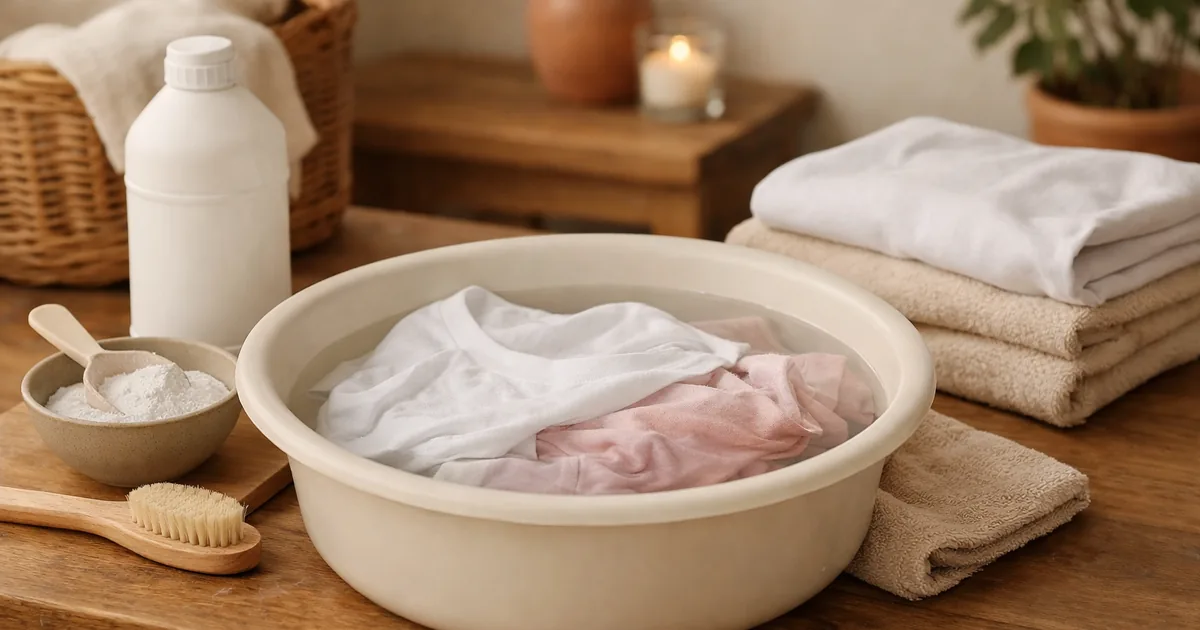
- Press, don't rub. Submerge in neutral detergent and repeat a gentle push-and-release with your palms. If you must use a machine, the wool cycle plus a mesh bag is the minimum.
- Never wring. Roll the garment in a dry towel and press the water out. Twisting shifts the fibres past each other and the shape goes with them.
- Dry flat. Hanging a wet knit stretches the shoulders and hem under its own weight. Lay it on a dry towel in its original shape.

Plenty of guides promise to rescue a shrunken knit. Start from the fact that full recovery is not possible. Soaking in lukewarm water with a little hair conditioner or wool detergent, then easing the fibres open a little at a time and reshaping flat, can soften the result. It works by lubricating the locked scales so they can be forced apart — which does not return the garment to its original measurements.
The one check to run before the first wash
New garments account for most accidents. Excess dye is still present, shrinkage happens on the first cycle, and trims meet water for the first time. Two checks are enough.
| Check | How | If it fails |
|---|---|---|
| Colour bleeding | Rub a hidden area (inside hem, seam allowance) with a damp white cloth for about 20 seconds | Colour on the cloth → wash separately for the first few cycles |
| Trims | Check whether buttons and decorations are sewn or glued | Glued trims can detach in water → turn inside out, use a mesh bag |
The bleed test takes twenty seconds, and skipping it is behind a large share of dye-transfer disputes. What to do when colour has already transferred is covered in the stain and discolouration guide.
Mistakes you cannot undo
- Wool or cashmere in a warm machine wash — felting shrinkage, effectively unrecoverable.
- A hot iron on polyester or nylon — the surface melts and leaves a permanent sheen. If the iron symbol shows one dot, respect it.
- Bleaching against a "do not bleach" symbol — patchy colour loss is more visible than the original stain.
- Hanging a wet knit — stretched shoulders don't iron out.
- Fabric softener on technical outerwear — the coating suffocates the water-repellent and breathable finish.
- Leaving wet laundry in the drum for hours — dye transfer and odour arrive together. The machine side of this is in washing machine care and bulky items.
That covers not ruining the garment. Storage is a separate problem in humid months, and managing humidity and mould in monsoon season is the companion piece. If you're reorganising the kitchen at the same time, use-by dates and food storage follows the same logic.
Sources and where to verify
- Korean Agency for Technology and Standards — KS K 0021, care labelling code using symbols (current edition issued 31 December 2024)
- Korean Agency for Technology and Standards — safety standards for household goods
- Korea Consumer Agency textile committee findings — analysis published on the North Jeolla Province consumer board
Written as of July 2026. Symbol systems and fibre behaviour change slowly, but KS standards are revised, so check the standards page above for current wording. The Consumer Agency statistics come from published findings; the agency's own site blocks automated access, so they were cross-checked against a public-sector republication and press coverage rather than read at source. One more note: many guides quote shrinkage percentages by water temperature. No credible test data could be found for those, so they are not used here.