Osteoporosis is called the "silent thief." Bone weakens with no symptoms until, one day, a minor fall snaps a wrist, spine, or hip and you finally learn it was there. It speeds up sharply in women after menopause — but with early awareness, it's very preventable. Here's the cause, the test, and how to protect your bones.
Why women are at higher risk
Bone constantly breaks down old bone and builds new, and estrogen keeps that balance. When menopause removes estrogen, breakdown outpaces building, and bone density falls fast in the 5–10 years after menopause.
| Risk factor | Detail |
|---|---|
| Menopause / female | Estrogen loss accelerates bone loss |
| Age / thin build | Older and low body weight raise risk |
| Family history | Parental fracture or osteoporosis |
| Lifestyle | Smoking, heavy drinking, inactivity, low calcium |
| Meds / disease | Long-term steroids, thyroid, rheumatoid conditions |
So female + menopausal + thin + family history calls for extra care. Start bone care around when menopause begins.
The trap: no symptoms
Osteoporosis itself doesn't hurt, so the first sign is often a fracture. These appear only once it's advanced:
| Sign | Meaning |
|---|---|
| Losing height | Possible spinal compression fracture |
| Stooped back | Spinal deformity (kyphosis) |
| Fracture from minor impact | Fragile wrist, spine, hip |
| Chronic back pain | Accumulated micro-fractures |
Key. A hip fracture directly affects later-life quality of life — long bed rest after one rapidly weakens muscle and heart-lung fitness. So osteoporosis goes hand in hand with fall prevention (preventing falls).
The test — reading your T-score
Osteoporosis is diagnosed by a bone density scan (DEXA), reported as a T-score.
| T-score | Result |
|---|---|
| -1.0 or above | Normal |
| -1.0 to -2.5 | Osteopenia (warning stage) |
| -2.5 or below | Osteoporosis |
If you have risk factors, get scanned soon after menopause rather than waiting (reading lab numbers).
Prevention ① calcium & vitamin D
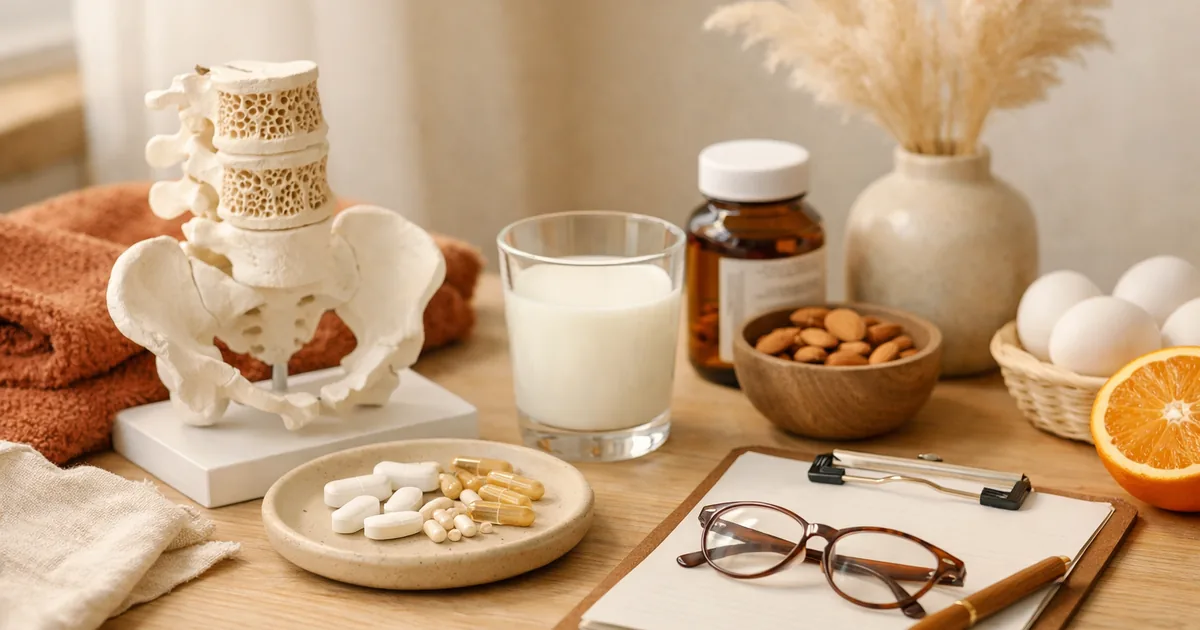
Bone's raw material is calcium; vitamin D helps absorb it. They work as a pair.
| Nutrient | Daily (adult) | Sources |
|---|---|---|
| Calcium | ~800–1,000 mg | Milk, yogurt, cheese, tofu, greens, small fish |
| Vitamin D | ~800–1,000 IU | Sun (2–3×/week), oily fish, eggs, supplements |
Mostly indoors? Vitamin D runs low easily — use a supplement if diet falls short, checking the dose.
Prevention ② exercise — load the bone
- Weight-bearing — walking, jogging, stairs; loading stimulates density.
- Strength training — muscle supports bone and cuts falls; 2–3×/week.
- Balance work — single-leg stands, yoga, tai chi to prevent falls.
- Stop heavy drinking and smoking — they weaken bone directly.
Treatment — if you already have it
Once diagnosed, lifestyle care is paired with medication — drugs that slow bone loss (bisphosphonates) or build bone, and in early menopause hormone therapy may protect bone. Decide with your doctor based on density and fracture risk.
FAQ
Can I just take lots of calcium?
Calcium alone isn't enough — you need vitamin D to absorb it and exercise to store it in bone. All three together. Excess calcium risks kidney stones, so keep to sensible amounts.
Should young women bother?
Yes. Bone mass peaks around age 30, then declines. Building a higher peak young greatly delays later osteoporosis. Crash dieting lowers bone density.
Is osteopenia already too late?
No — it's a reversible warning stage. Calcium, vitamin D, and exercise now can slow the slide to osteoporosis.
Osteoporosis advances silently but is one of the most preventable diseases. A bone scan around menopause, plus calcium, vitamin D, and weight-bearing exercise — those three are the core.
This is general information, not a diagnosis or prescription. Bone density and fracture risk vary — consult an orthopedic or endocrine specialist. See also menopause and iron-deficiency anemia.