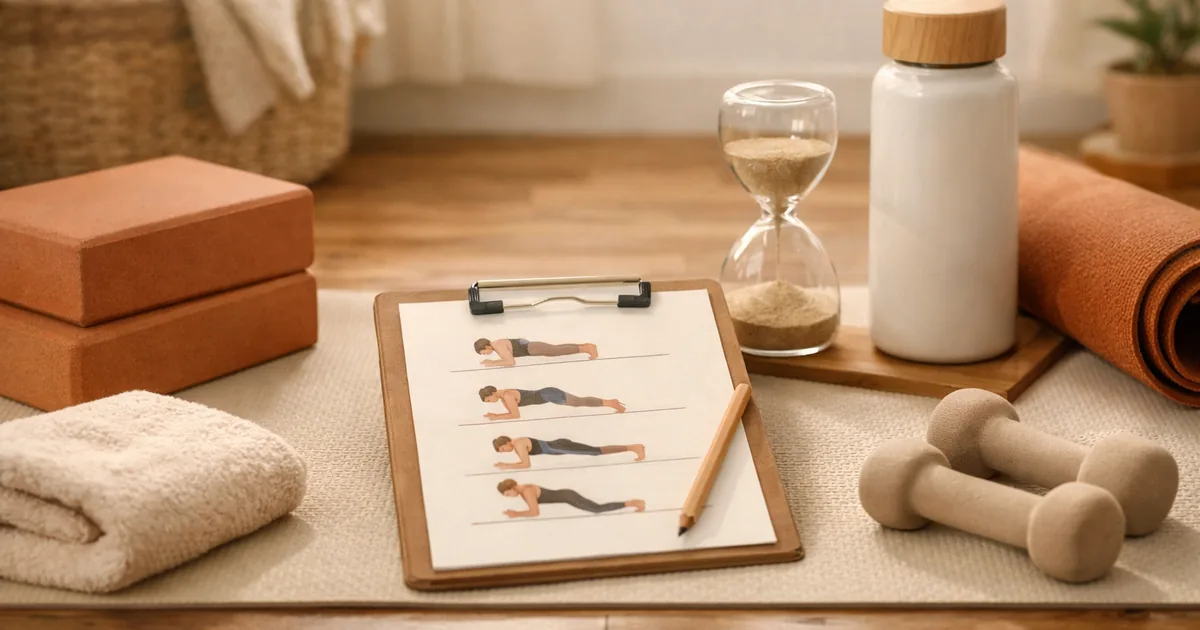
When people think "core exercise," the plank comes to mind first. No equipment, no noise, just a mat — it's the best move for training your whole center. But mindlessly holding for as long as possible mostly hurts your back and does little else.
What matters isn't time — it's form and picking the right difficulty for you. From knee planks to shoulder taps, here are five progressive levels. Start today with the one that fits you.
Before you start: every plank comes down to a straight line from head to hips to heels. If the hips rise or sag, the benefit disappears and the back takes the load. Brace hard, and stop if your back hurts.
① Knee plank (beginner, minimal back strain)
If a full plank is too hard, start here. Rest your knees on the floor and support the upper body on your forearms. Keep a straight line from knees to head. Much lower strain — perfect for beginners or weaker backs.

② Standard plank (the anterior-core classic)
Elbows directly under the shoulders, on your toes, hold a straight line from head to heels. Don't let the hips rise or sag — brace the abs and glutes together. Rather than holding forever, stop just before form breaks down.

③ High plank (wrists and shoulders too)
Arms straight, palms pressing into the floor, body in a line. Hands under the shoulders. It works the shoulders, arms, and wrists more than the forearm plank — a good step before moving on to push-ups.

④ Side plank (obliques, lateral core)
Lying on your side, prop up on one forearm and lift the hips. Keep the body in line, not tipping forward or back. It hits the obliques the front planks miss. If it's hard, bend the knees and rest them on the floor.

⑤ Plank shoulder tap (stability boss level)
From a high plank, lift one hand to tap the opposite shoulder and return, alternating sides. The trick is not letting the hips rock side to side — it sharply improves core stability. Try it once your form is solid.

How much, and how to progress
Pick the one move that fits your level and start with 3 sets. Once you can hold 20–40 seconds without form breaking down, move up a level.
| Level | Move | Goal |
|---|---|---|
| Beginner | Knee plank | Steady 30 sec × 3 |
| Standard | Standard / high plank | 40 sec × 3 |
| Advanced | Side plank / shoulder tap | Balanced both sides |
Three to four times a week is plenty. The core recovers quickly, so every other day works fine.
Common mistakes
- Sagging hips — the strain lands on your back. Brace the abs and tuck the pelvis slightly.
- Piked hips — easier, but the core stops working. Keep the body in a line.
- Holding your breath — breathe slowly throughout. Don't strain until you turn red.
- Craning or dropping the head — it strains the neck. Look at a spot on the floor, neck neutral.
FAQ
Is holding a plank longer always better?
No. A clean 30 seconds beats a sloppy 2 minutes. Instead of adding time, add difficulty — side planks, shoulder taps — for better returns.
Will planks alone burn belly fat?
Spot reduction isn't real. Planks build core muscle, but belly fat comes down to diet and overall body fat. More on that in the core & ab moves.
Can I do them every day?
Light intensity daily is fine, but rest a day if you're sore. Three to four times a week balances recovery and results.
Planks are won by "how straight," not "how many seconds." Start by building that straight line with one move at your level.
This is general health information and does not replace medical diagnosis or treatment. If you have a back or shoulder condition, or pain persists, consult a specialist. See also our core & ab moves and home-workout basics.