You keep meaning to work out, but a gym membership feels like a lot and every YouTube routine has thirty moves. In reality, five bodyweight moves done properly are enough to build real full-body strength.
These are the five fundamentals for home-workout beginners. Nothing complicated — a mat is all you need.
Before you start: form beats reps. Move slowly without swinging, and don't hold your breath. Stop for sharp pain, and check with a professional if you have an injury or condition.
① Squat (whole lower body)
The most basic of basics. Feet shoulder-width, push the hips back as if sitting into a chair. Don't let the knees drive far past the toes; look ahead. Thighs parallel to the floor is the goal, but go only as deep as feels comfortable at first.

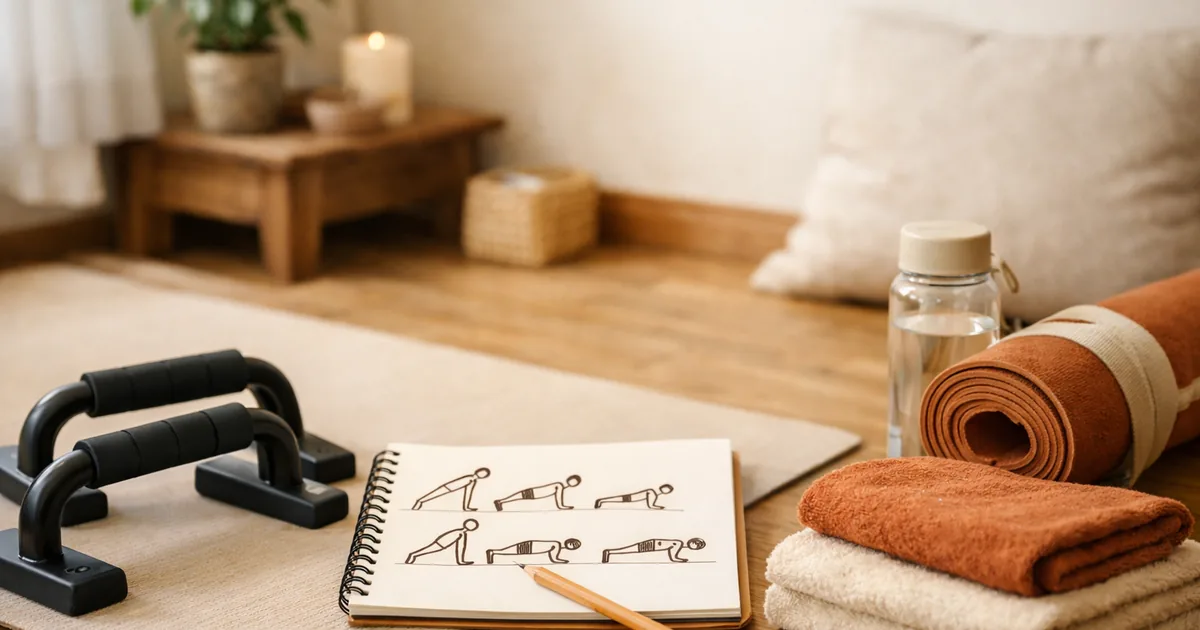
② Knee push-up (chest and arms)
If full push-ups are too hard, start with your knees on the floor. Hands slightly wider than the shoulders, body in a straight line, lower until the chest nears the floor and press back up. Don't let the hips pike up.

③ Plank (core)
Support yourself on forearms and toes with a straight line from head to heels. Brace the abs so the hips neither sag nor rise. If 30 seconds is too much, start at 15. Form matters more than duration.

④ Hip hinge (glutes and back chain)
Standing with knees softly bent, push the hips back and fold the torso forward, then stand tall. Don't round the back — fold with a flat back. It's also the safe way to pick things up, so it protects your lower back.

⑤ Bird dog (balance and core stability)
On hands and knees, extend one arm and the opposite leg, hold 3 seconds, then switch. The key is bracing the abs so the torso doesn't wobble. Excellent for stabilizing the lower back and preventing injury.

Make it a 20-minute routine
Do ①–⑤ once through, rest 1–2 minutes, and repeat for 3 rounds — about 20 minutes. Start with one or two rounds and build.
- Three times a week, every other day works well. Muscle grows during rest.
- Rest about 60 seconds between sets.
- After a couple of weeks, add reps first, then sets.
The most common beginner mistakes
- Going all-out on day one — you can't move the next day and skip three weeks. Start easy.
- Holding your breath — exhale on effort, inhale on the return.
- Training daily — the same muscles need recovery time.
FAQ
Can bodyweight alone build muscle?
For beginners, absolutely — your body weight is already meaningful resistance. Later, adjust reps and tempo or add bands.
Should I train through soreness?
Mild stiffness is fine, but pain that limits movement means a day or two off. Light walking and stretching aid recovery.
Isn't cardio better for weight loss?
You need both. Strength work protects your metabolic rate, so pairing it with cardio works better.
Home workouts are won by consistency, not intensity. Start with five moves, 20 minutes, three times a week.
This is general health information and does not replace medical diagnosis or treatment. If pain persists or worsens, consult a specialist.