Can't do a single push-up? No need to feel defeated. The push-up is a progression — change the angle and anyone can start. Here's the path from the wall to the floor, in order.
Shared rule: at every stage, keep head, hips and heels in a line. If the hips rise or the back sags, drop back an angle. Stop for wrist or shoulder pain and check with a professional.
① Wall push-up (stage 1)
Stand a step from a wall, place your hands at shoulder height, and lower your body toward the wall then press away. The lowest load, and a perfect starting point. Once 15 reps feel easy, move on.

② Incline push-up (stage 2)
Put your hands on something elevated — a desk, table, or sofa back — and press with the torso angled. The lower the surface, the harder it gets, so work your way down over time.

③ Knee push-up (stage 3)
On the floor with knees down. Keep a straight line from knees to head and lower until the chest nears the floor. Watch that the hips don't drift back toward your heels.

④ Negative push-up (stage 4)
This builds the strength to hold full form. From the top position on your toes, lower very slowly over 3–5 seconds, then drop to your knees to come back up. The lowering strength comes first.

⑤ Full push-up (stage 5)
Supported only on hands and toes. Hands slightly wider than the shoulders, elbows about 45° from the torso (flaring to 90° strains the shoulders). Starting with a single rep is perfectly fine.

When to move up a stage
Simple: when you can do 12–15 clean reps at the current stage without form breaking. Rushing ahead wrecks your form and loads the shoulders and wrists.
- Two to three times a week, every other day.
- Each stage usually takes 2–4 weeks — it varies, so don't rush.
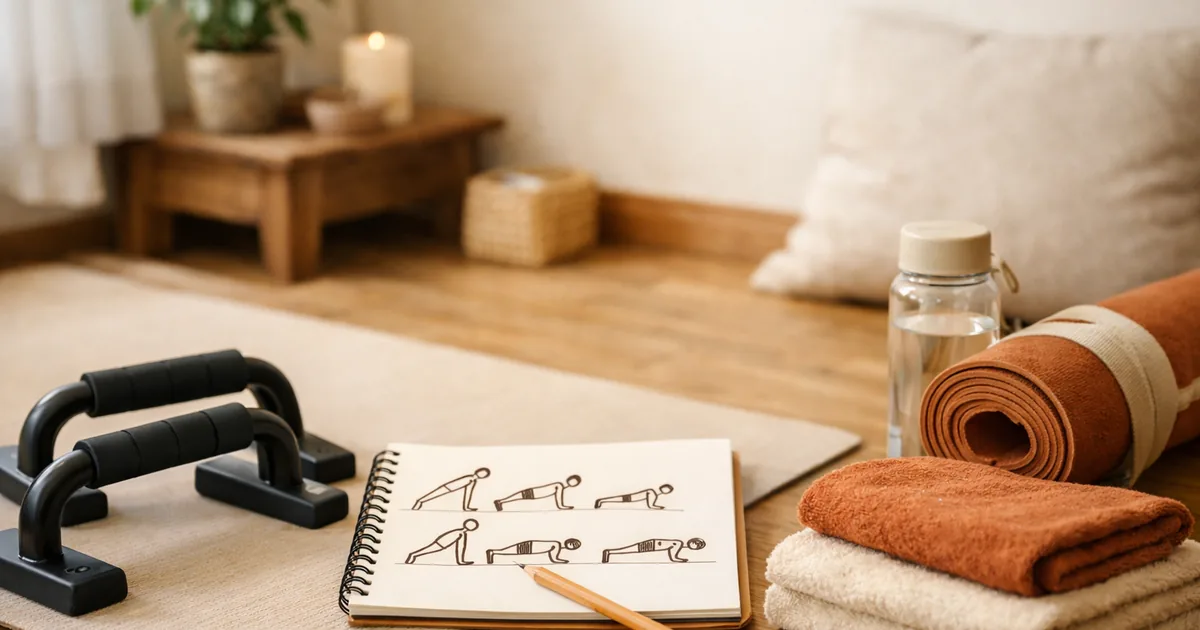
- If your wrists hurt, make fists or use push-up bars to reduce the strain.
FAQ
Which muscles do push-ups work?
Mainly the chest, with shoulders, triceps and core assisting — an efficient upper-body move.
Can I do them daily?
The same muscles need about 48 hours of recovery. Every other day beats daily for growth.
How wide should my hands be?
Slightly wider than shoulders as a default. Narrower hits the triceps, wider emphasizes the outer chest.
The push-up isn't a move you "can't do" — it's one with stages left. Start at the wall and you'll reach the floor.
This is general health information and does not replace medical diagnosis or treatment. If shoulder or wrist pain persists, consult a specialist.