Compound interest means your interest earns interest too. Enter a starting amount, a regular contribution, a return rate and a time horizon to see how much it grows.
| Time | Balance |
|---|
Calculates automatically. Switch "Result view" between monthly, yearly and 5-year steps to see the balance at each point. This assumes a constant rate of return and is an estimate only — taxes, fees and inflation are excluded. Not investment advice.
At a glance: what this calculator shows
With the defaults ($10,000 to start, $300 a month, 7% return, 20 years, monthly compounding), the future value is about $196,665. You only put in $82,000 of that — the other ~$114,665 is interest earned through compounding. The money it makes outgrows the money you add.
How compound interest works
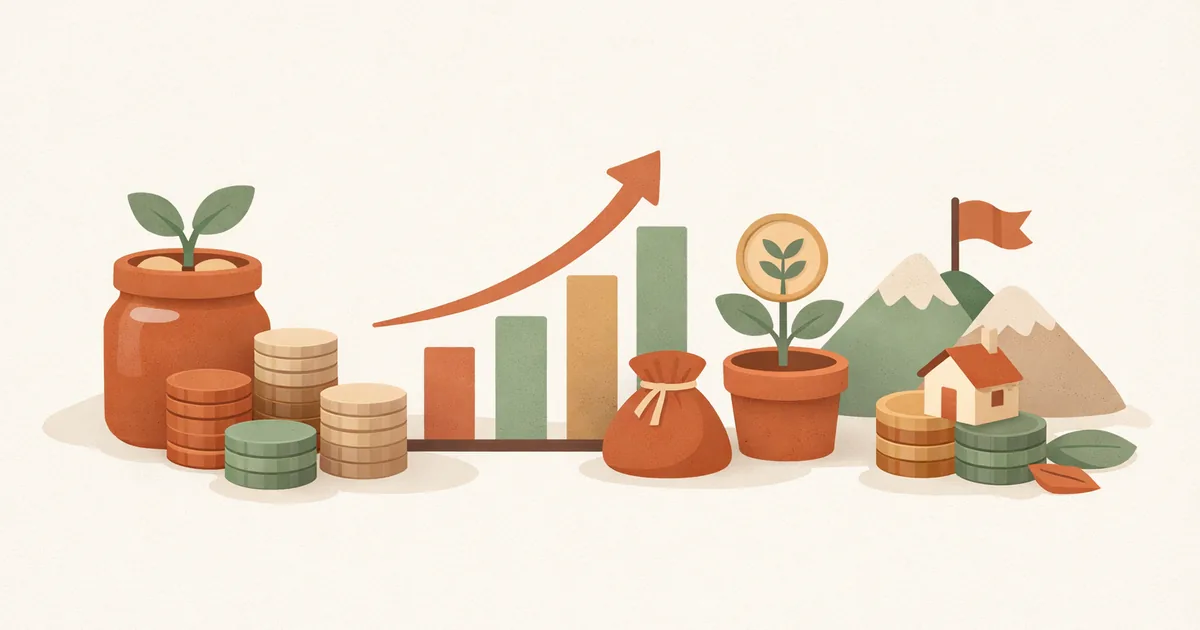
The idea behind compounding is simple: interest earns interest. With the same principal and rate, the curve gets steeper the longer you stay invested.
Future value = Principal × (1 + rate ÷ n)n × years
The contrast with simple interest is stark. Grow $10,000 at 7% for 20 years and simple interest gives you $24,000 — but compounding gives about $40,387. Add regular monthly contributions and the gap widens dramatically.
- Compounding frequency — at the same annual rate, reinvesting more often (monthly or daily) nudges the final amount slightly higher.
- Time is the multiplier — compounding does most of its work late. Compare the balance at 20 and 30 years to see it.
- Regular contributions — steady deposits grow the principal itself, widening the base every return is calculated on.
Frequently asked questions
What is the difference between compound and simple interest?
Simple interest is paid on the principal only. Compound interest is paid on interest too. Over a year or two the difference is small; over 10–20 years, compounding pulls far ahead.
How long until my money doubles?
A quick estimate is 72 ÷ your return (%) — the Rule of 72. At 7% that is about 10.3 years; at 6%, 12 years; at 4%, 18 years.
How much better is monthly than annual compounding?
More frequent compounding helps, but less than you would expect. Your rate, time horizon and steady contributions matter far more than how often interest compounds.
Are taxes and inflation included?
No. This is a pre-tax, nominal estimate. Interest and gains are taxed differently by country and account type, and inflation reduces what your final balance can actually buy.
What return rate should I use?
There is no single right answer. Use the stated rate for savings, and a conservative figure for investments. Try several rates to see best- and worst-case outcomes.
Starting early and staying invested can matter as much as the rate itself. Try increasing the time horizon in 5-year steps to see the effect.
This content is for general information only and is not investment advice. Base any decision on your own judgement and, where appropriate, a licensed professional.